The Last Twins
As the end of the second World War came in sight, the attitude of air forces towards the development of new twin-engined fighters was showed an uncomfortable split. Jet fighters would soon be displacing the single-engined piston-engined fighters because of their superior performance, but they appeared to leave open a niche for piston-engined fighters as nightfighters and attack aircraft. Not in the least because the first jet engines had a very high fuel consumption and limited thrust, and were a far from evident choice for a nightfighter, a heavy fighter-bomber, or a carrier aircraft. Nevertheless the writing was clearly on the wall for the heavier piston-engined fighters too.
The swan song would consist of a number of types that were only partially successful, as they were plagued by technical and operational problems. Technological overstretch explains part of these issues. But no doubt it was also a factor that they were operating in peacetime, and risks that would have been accepted as necessary in wartime, were no longer tolerated.
Hornet
Perhaps the type with the greatest legacy to live up to was the de Havilland Hornet, designed during the war as a smaller development of the Mosquito. It was considered that by using the layout and aerodynamics of the Mosquito as basis, the risks of development would be kept low, while the adoption of a smaller airframe, improved streamlining, and the latest Merlin engines would provide high performance. Nevertheless the risk of built-in obsolescence was clear, as de Havilland was already working on the D.H.100 Vampire jet fighter. What finally convinced the Air Staff was the potential of the D.H.103 as a twin-engined long-range fighter for use in the final phase of the war against Japan.
To make this feasible, the Air Staff decided to order it even before the first prototype flew, in the hope of receiving the first production aircraft in December 1944. Specification F.12/43 envisaged it as a long-range day fighter with a top speed of no less than 772 km/h. The Merlin 130/131 series of engines was employed, which was carefully redesigned to permit an aerodynamically very clean installation, and “handed” to have the propellers rotate in opposite directions. As the radiators were in the wing leading edge, the Merlin 131 did not only have a different direction of rotation for its propeller; it had a relocated coolant pump and a reverse coolant flow. Later the Merlin 134/135 would be fitted, with a different throttle.
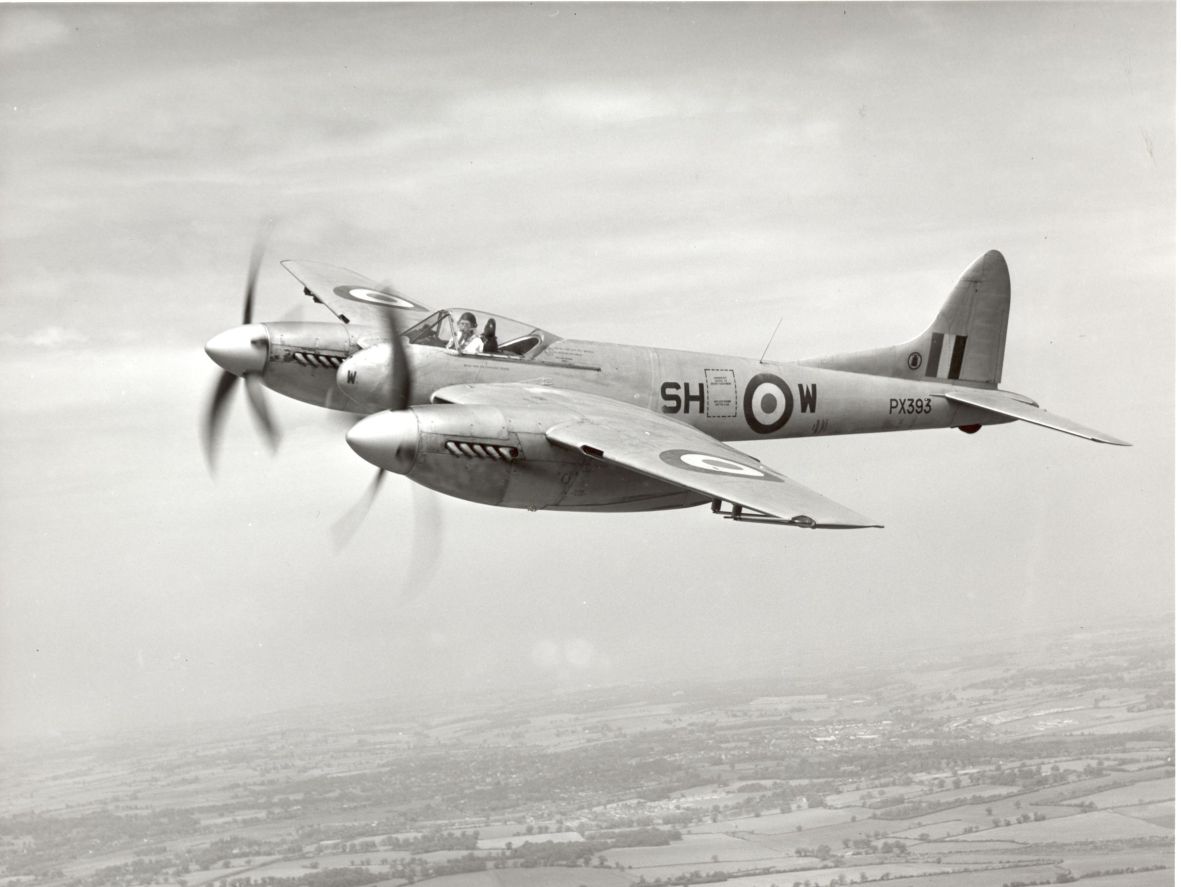
The DH.103 was the smallest possible package that could be designed around two powerful engines, four 20-mm cannon, a pilot and enough fuel for a 1600 km endurance (2000 km with external tanks). The specification emphasized the highest possible speed, rate of climb and manoeuvrability, and in these regards the Hornet did not disappoint. Contrary to expectations, the aerodynamics were not trouble-free, but nevertheless development was rapid. The first prototype flew in July 1944 and demonstrated a top speed of 790 km/h at 7,500 m, which was certainly impressive, though production aircraft, delivered from February 1945 onwards, were slower. If the war in the Pacific had continued until 1946, as anticipated, the Hornet could have played a vital role. Instead the early end of the war curtailed the production run for the RAF at 193. They would serve until 1955: Their usefulness as fighters was short-lived but they were effective strike aircraft, and saw action in Malaya.
The story did not end there, as the Royal Navy showed interest in the type. During the war it had evaluated the Mosquito for shipboard use, and even ordered the production of a small series of Sea Mosquito TR.33 torpedo-bombers, which had a short service life. It did see something in the Sea Hornet as long-range fighter, and wrote specification N.5/44 around a carrier version with folding wings, modified landing gear, and an arrester hook. It has to be remarked that technologically, the Hornet was different from the Mosquito in construction, featuring a mixture of metal and wood with Redux bonding, and was expected to survive better in a damp environment than the wooden Mosquito. The first Sea Hornet F Mk.20 flew in April 1945. It remained a big aircraft for the RN’s wartime carriers, especially as the wings folds were well outboard of the engines, giving it a large footprint when parked. The Fleet Air Arm would take only 27, equipping one squadron.
The next Navy version, the Mk.21, was a nightfighter. However, this revealed the limitations of the Hornet’s design, as the airframe did not have room for a large state-of-the-art radar set. The Mk.21 had to make do with a small ASH set in a thimble radome, in an elongated nose that put it just in front of the large four-bladed propellers. And a decidedly cramped and uncomfortable compartment for the radar operator was arranged in the aft fuselage behind the wing trailing edge, under a small dome. Because the Hornet was so small, the additional weight of the radar installation seems to have had a serious performance impact. The type had obvious limitations, not in the least the very limited range of its radar, but as it was the best available option (the RN studied the acquisition of larger aircraft but had to conclude that development times would be long), production began in 1948. Eighty were delivered. Again there was only one front-line squadron to operate it.
The Hornet was a great technical achievement but obsolescent by design. It was optimised for high performance at a time when it was obvious enough that jet fighters would soon leave it far behind. Both customer and manufacturer knew this, and they accepted it because the Hornet was only wanted for a final wartime campaign, which never happened. Its life did not stretch much beyond that because it was too small to have much development potential. If the RAF commented that the cockpit of the single-seat fighter was too small and uncomfortable for long missions (though pilots seems to have like the inclined seat which increase their G tolerance), the two-seat nightfighter was even worse with conditions for the radar operator that hampered his effectiveness.
FMA I.Aé.30 Ñancú
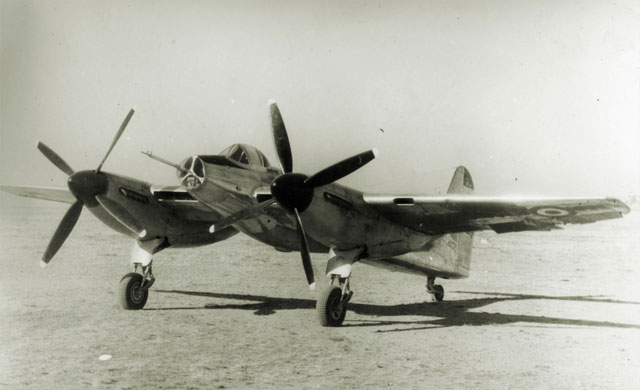
One of the last twin-engined piston fighters emerged in Argentina, as late as 1948. Designed by an Italian engineer who had emigrated to Argentina, Pallavicino, the Ñancú was conceived to be an interceptor and long-range escort fighter. Conceptually, it was superficially similar to the de Havilland Hornet, but entirely of metal construction. The three prototypes had similar clean lines with a sleek and streamlined fuselage, 2035 hp Rolls-Royce Merlin 134/135 engines, and radiators buried in the leading edges of the wing inboard of the engines. Much of its wing planform and engine nacelle design had a strong de Havilland flavour to it. The new aircraft made its first flight on 17 June 1948.
The performance of the new fighter exceeded the expectations of its designers, a rare enough occurence. Performance was indeed impressive, with a top speed of 740 km/h, even a bit better than that of Argentina’s first jet fighter prototype, the disappointing I.Ae.27 Pulqui. The Ñancú was not a small aircraft, with a wing span of 15 m, an empty weight of 6208 kg, and a maximum take-off weight of 8755 kg: It carried enough fuel for a 1500 km radius of action and could fly 5000 km with external fuel tanks, though Pallavicino vetoed a plan to fly the Ñancú prototype across the South Atlantic and show it at Farnborough.

The production aircraft were to be powerfully armed with four or six 20-mm HS-804 cannon in the lower fuselage below the cockpit, and the ability to carry rockets and light bombs. The first prototype was unarmed, with a plexiglas nose cone to improve downward view. And although the first prototype apparently handled well, modifications of the tail surfaces were planned for the second prototype, which was never completed. It also was to carry armament and have a redesigned cockpit canopy.
As impressive as the Ñancú was, it nevertheless represented old technology. Argentina was taking delivery of Gloster Meteor jet fighters, and Kurt Tank was already working on the advanced Pulqui II jet fighter. Thus plans to order 210 were cancelled in 1949, also for cost reasons. Pallavicino proposed jet-powered developments, but these remained dead letter.
Twin Mustang
There was another attempt to create a heavy fighter quickly by taking advantage of the aerodynamics of an existing type: The North American P-82, later F-82, Twin Mustang. The desire was the same: to have a long-range fighter for the final phase of the Pacific War. When the F-82 was sketched in the middle of the war, the long-range versions of the P-51 were not yet in service, and besides, long escort missions put a lot of strain on the pilot of a single-seater. Compared to the Hornet, the American fighter had a different set of design priorities, and the result was an aircraft of which the empty weight was a bit heavier than the loaded weight of the Hornet. Or, the weight difference was some two tonnes empty, and four tons loaded, as the result of the US fighter being designed for a crew of two, more range, and a heavier war load.
Superficially, the P-82 looked like two P-51 Mustang fighters connected to each other by a new central wing section and a new horizontal tail. But there were quite a few design changes under the skin, and apart from the engine installation, the XP-82 prototype had no parts in common with the P-51 production line. Designer Edgar Schmued had initially studied a number of different configurations for a twin-engined long-range fighter, before settling on a twin-boom design without central nacelle as the most efficient. The XP-82 copied the proven aerodynamics of the P-51, specifically the refined XP-51F, but it was a new design in detail.
The twin-boom configuration dictated a number of features, such as longer fuselages and very different landing gear. Less visible was that the wing also had a longer chord, so that the outer wing panels were not those of the P-51. All gun armament was removed from the outer wing panels and moved to the wing center section. The wings were strengthened and provided with hardpoints for the carriage of external fuel tanks or bombs. The gun armament was six Browning .50 machine guns, albeit soon upgraded the faster-firing M3 version, but a pack with eight more could be carried under the center section. And under the skin, the P-82 was given the latest in electronics and electrical engineering, which unfortunately turned out to be a maintenance nightmare. The aircraft was flown primarily from the left cockpit, with more limited equipment in the right cockpit. The off-centre position of the cockpits turned out to be no disadvantage for aerobatics.
The USAAF ordered prototypes powered both by the Merlin (in its Packard V-1650-23/25 form) and by the equivalent Allison V-12 (the V-1710-119). It also ordered 500 Merlin-engined P-82B production aircraft “off the drawing board” well before the first prototype flew, in another similarity with the Hornet. That first flight happened in June 1945, with considerable difficulty: The original engine installation, with the “handed” engines turning so that the blades rotated upward over the center section, caused the center section to stall, and the engines had to be swapped. (Something similar had happened to the Hornet.) Other than that, the P-82 behaved well.
But it was too late for WW2, and that had consequences for the small post-war production run, although it allowed for some further refinement of the design. Because Rolls-Royce now wanted to a charge a $6000 license fee per engine for the US production of the Merlin, this was ended, and P-82B production was abruptly curtailed after 20 deliveries. The air force now opted to have V-1710 engines in the production P-82 series. Allison had developed the V-1710 to the equivalent of the Merlin 61 series, i.e. with a two-stage supercharger and an aftercooler, to achieve better high-altitude performance without having to resort to turbo-charging. The F-32R (the military -119) series and its developments had several very advanced features and impressive performance on paper. The final version chosen for the P-82 production was the V-1710-143/145, in theory good for 1600 hp on take-off and a 2250 hp War Emergency Rating at 3200 rpm, but suffering from backfires and reliability issues that caused its performance to be downgraded in service, running on 60 inches of manifold pressure instead of 90. The delivery of the production aircraft was delayed by about a year while Allison struggled to resolve the problems. North American was convinced that it had solved the problems when it proposed to install a backfire screen (a raster to prevent ignition of the gas in the intake manifold) but Allison did not accept this.
Fundamentally, the -143/145 stretched the engine technology of the time a bit too far, and the hurdles were never satisfactorily overcome. Performance limitations were put in place and P-82 pilots gained a lot of single-engine flying time. The notional top speed of 742 km/h at 6400 m (for the P-82G nightfighter) was probably fraught with risk, thought one assumes that it it ever had come to intercepting nuclear-armed enemy bombers, crews would have taken their chances.
Apart from some prototypes and small series, the USAF took 100 P-82E (later redesignated F-82E) day fighters and 150 P-82F, P-82G and P-82H all-weather fighters equipped with radar in a long pod, slung below the wing center section and extended well ahead to put the radar in front of the propeller blades. The pod was given the nickname “pickle” or less gentlemanly “dong” and contained various types of radar, such as the SCR-720, the more compact but less powerful AN/APS-4, or the APG-28. The second pilot, in the right-hand cockpit, became the radar operator. With the large radar pod installed, gun armament was restricted to the six .50 machine guns, which left the P-82 seriously under-gunned for night interception of heavy bombers. It also lacked airbrakes and was considered not maneuvrable enough for the job, with a rather poor view directly forward due to the long engine cowlings. However, while the Air Force awaited delivery of the interim F-94 Starfire and final F-89 Scorpion jet all-weather fighters, the P-82 was urgently needed as stop-gap solution to replace the war-weary P-61. As it was a fairly big and powerful aircraft, performance didn’t suffer much by the addition of the radar.
Operational aircraft were delivered between 1946 and 1949, with obsolescence setting in during the production run. They nevertheless gave essential service providing air defense for the continental USA. The F-82H model was winterised for operations in Alaska, as this was the shortest route for Soviet bombers, and Twin Mustang operations there continued until 1953. The type also saw brief service in the Korean war, where their range made them effective on intruder and interdiction missions, but a lack of spare parts cut their combat career short. Operations were limited in scope and directed against fixed targets only, to economize on scarce flying hours. Nobody had expected the F-82 to last very long.
The official USAF history would attribute the limitations of the Twin Mustang to the failure of the V-1710-143/145 engine to live up to the (sky-high) expectations, and that was fair enough. With a more reliable engine, the F-82 could have had a longer career, judging by the longevity of the ancestral P-51, and its service record in Korea. But it was fundamentally a transitional type, as the last USAF piston-engined fighter to enter service.
Tigercat
The other American twin-engined fighter very much fit the same pattern, but with an interesting twist as it was a naval aircraft. When the war ended in 1945, the US Navy was awaiting completing of the carriers of the Midway class. At 45,000 tons water displacement (59,900 tons fully loaded), USS Midway was over 60% bigger than the wartime Essex class. She had a longer flight deck, about 300 m against about 260 m for the Essex class, but this did not account for all the growth: The class needed to have a bigger hull because they had an armoured flight deck. Nevertheless, its availability induced the Navy to embrace bigger and more complex aircraft, including twin-engined types. For the most part this prompted the construction of a number of exceedingly complex and unsatisfactory prototypes, before the USN relented and opted for simpler types.
The somewhat more fortunate exception was the Grumman F7F, ordered as early as June 1941, thus approving the G-51 proposal of Grumman, which incorporated the lessons learnt from the F5F. At first the type was also planned to be produced for the USAAF as the XP-65, but soon it was concluded that the requirements of the two services were too different: The USAAF wanted a high-altitude interceptor with turbocharged engines, a pressurised cockpit, and a pair of 37-mm cannon instead of the four 20-mm cannon of the Navy type. Thus the XP-65 was abandoned to avoid compromising the F7F too much.
Development would be slow, as the F7F had lower priority than the F6F, which was ordered on the same day. The F6F was wanted in combat as soon as possible, so its made its first flight in June 1942 and still entered production in the same year. Development of the F7F was considerably slower: Its first flight was made in November 1943, and the first batch of 34 F7F-1 fighters was delivered to the US Marine Corps between April and October 1944. (USS Midway would be commissioned after the end of the war.) There seems to have been no urgency to deploy the type, and although USMC-operated Tigercats arrived at the front in the last days of the war, the F7F did not see combat in WWII. Afterwards, it had a dithering development history, suggesting that the USN and USMC did not quite know what to do with it.

It looked attractive enough. The F7F had a well-streamlined fuselage with, in stark contrast to the F5F, a long tapering nose. The wing carried two big R-2800 radials in substantial nacelles. The prototypes featured big propeller spinners in an attempt to reduce drag, but these were soon omitted. The F7F had tricycle landing gear, which was a first for a carrier aircraft. Similar in size and weight to the P-82, the F7F was rather more heavily armed, with four 20-mm Hispano cannon in the wing roots, four .50 Browning machine guns in the nose, and the ability to carry an array of bombs and rockets up to a total of 2087 kg. Grumman had developed a heavy fighter-bomber, whose direct rival was the F4U Corsair, and this in part would be the Tigercat’s undoing as the Corsair was very successful in that role.
The F7F could also serve as a nightfighter, so the F7F-2N featured a compartment for a radar operator behind the pilot and AN/APS-6 radar in the nose, while the machine guns were removed. A production run of 65 was delivered. The fully developed form of the Tigercat was the F7F-3, which featured a larger vertical fin and rudder to resolve stability issues, stronger wings, R-2800-34W engines, and changes to the hardpoints under the wings and the fuselage to enable it to carry a heavier war load and even a Mk.13 torpedo. Of an order for of 250, at least 60 were completed as F7F-3N nightfighters with SCR-720 radar. Some 60 F7F-3 and -3N were modified into F7F-3P reconnaissance aircraft. The production run closed with a dozen F7F-4N models that featured additional inner wing strengthening and modified landing gear, and finally qualified for carrier operations. Production was ended in November 1946 with the 364th Tigercat.
The career of the F7F was thus rather short and not altogether satisfactory. Part of the problem was the introduction on carriers of a big, fast aircraft with tricycle landing gear. While its ample engine power and quick acceleration ensured a good take-off, it proved difficult to land, with occurrences of structural damage as the result of catching the arrester wires off-centre. This was enough for the USN to condemn the type as not satisfactory for carrier landings and hand it over to the USMC. The Marines welcomed the opportunity to acquire a nightfighter, but even they found it a handful. The final development of the F7F-4N addressed the issues, but this was a qualified success as the type was finally accepted for carrier use, too late for it to become operational.
The F7F was fast despite its size, only a little bit slower than the Sea Hornet, with a good rate of climb. Pilots found it agreeable to fly, but also observed poor harmony of control with a very light power-boosted rudder but heavy ailerons, which solidified in fast dives and provided ineffective control in the landing configuration. A small twin-engined aircraft with very powerful engines needs careful aerodynamic design to ensure that it remains controllable in all conditions and also with one engine out, and in this respect the F7F was not entirely successful, though presumably the bigger tail of the F7F-3 helped. In particular carrier landings on a single engine were not feasible. Fortunately the R-2800 was a very reliable engine.
For land-based operations the F7F was a good aircraft, as it was powerful, rugged, and well armed. The Tigercat did see combat in the Korean War, between 1950 and 1953, with Marine Corps nightfighter squadrons, flying intruder missions against ground targets, flying ahead of B-29 formations to suppress enemy defenses, and intercepting Po-2 biplanes that were on night harassment missions. They were useful not in the last place because F-82 operations were restricted by a lack of spare parts and low serviceability, so the USMC flew the bulk of night missions using its F7F-3N and F4U-5NL fighters. However, the appearance of the MiG-15 made the obsolescent fighter vulnerable, and its career came to its end. The F7F was replaced by the F3D jet fighter, which was not entirely satisfactory either.
In the final accounting, one is tempted to speculate that if the F7F would have been a successful carrier type, the USN would have embraced the opportunity to have a good carrier-based nightfighter, as the single-seat nightfighter models of the F4U had significant limitations. But when the Tigercat was restricted to land-based operations, the future of the F7F was severely affected. On paper it could have had a second career as heavy fighter-bomber, but in that role it faced stiff competition from the F4U and AD.
| Sea Hornet Mk.21 | F-82G | F7F-2N | |
|---|---|---|---|
| Engines | Rolls-Royce Merlin 133/134 | Allison V-1710-143/145 | Pratt&Whitney R-2800-22 |
| Rating | 2030 hp | 2250 hp | 2100 hp |
| Wing Span (m) | 13.72 | 15.73 | 15.70 |
| Length (m) | 11.28 | 12.86 | 13.88 |
| Height (m) | 4.31 | 4.22 | 4.19 |
| Wing Area (m2) | 33.54 | 37.90 | |
| Empty Weight (kg) | 6,455 | 7,256 | 7,270 |
| Loaded Weight (kg) | 8,856 | 11,744 | 9,838 |
| Max. Speed (km/h) | 692 km/h at 6700 m | 734 km/h at 6400 m | 724 km/h |
| Climb | |||
| Ceiling (m) | 11,125 | 8,630 | 12,375 |
| Range (km) | 2,980 | ||
| Fixed Guns | 4 × 20 mm Hispano HS.404 | 6 × 12.7 mm Browning .50 M3 | 4 × 20 mm Hispano M2 |
Tupolev Tu-1
The Soviet Union also took part in the WW2 concept of converting a fast bomber into a fighter, selecting to implement it based on the excellent Tu-2 bomber family, of which the Tu-2S had entered service in late 1942. But they waited until 1947 to fly the Tu-1, alias 63P. That designation indicated that it was a fighter development of the 63, a fast day bomber extrapolation of the family with in-line instead of radial engines.
The Tu-1 was envisaged as a day and night interceptor and a long range escort fighter, to be equipped with the PNB-1 (alias Gneiss-7) radar, which was a development of the German FuG-220 set. It was to have AM-43V engines driving four-bladed propellers, for a performance gain over the basic Tu-2S, but because of the slow development of these engines the Tu-1 would only fly in 1947. It was powerfully armed, with two NS-45 in the lower nose, two NS-23 in the wing roots, and 12.7 mm UBT guns in dorsal and ventral defensive positions. Its performance, including a top speed of 641 km/h at 8600 m, was considered satisfactory, but the engines were unreliable.
And in 1947 the sleek, menacing lines of the 63P could not hide its fundamental obsolescence; its performance was no longer good enough. And the AM-43V engine would never enter production. The 63P prototype nevertheless served a useful purpose as the USSR’s first radar-equipped fighter.
Leave a Reply