Postscript
It is a truism that a successful aircraft type needed to achieve a balance of features, the result of the right set of design priorities: All engineering involves compromises. The difficulty for the designers of the 1930s and 1940s was to figure out which compromises to make at a time of rapid technological evolution and under the stress of war production. Generally, a too conservative approach did not pay off, as designers needed to take some risks if they were to design aircraft with sufficient longevity.
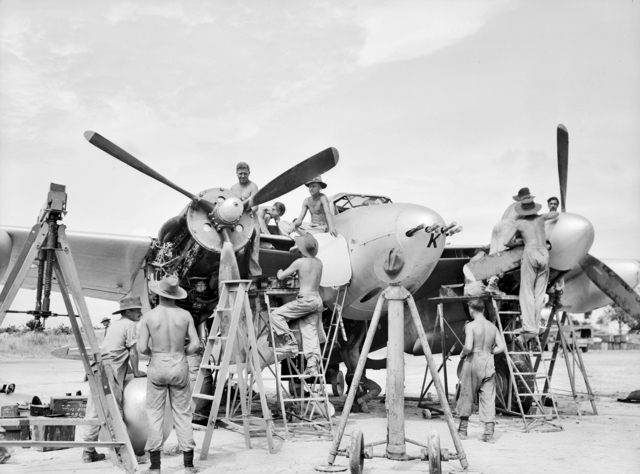
What was the best compromise for a twin-engined fighter in the 1935-1945 period? Looking back at the history of the types, the main factors were size and complexity. A too small aircraft might be able to compete in speed and agility with the single-engined fighters, but only at the price of not having any benefits that justified the cost of two engines: The Focke-Wulf Fw 187, Westland Whirlwind, and Lockheed P-38 were ultimately uneconomic. The USA could afford the P-38 but still recognized that the P-51D could do the same job at lower cost.
At the other end of the scale, featuritis drove the development of aircraft that were far too complex, too heavy and too big to be competitive; weird wonders such as the Lockheed XP-58 and Vickers 432. Arguably the Northrop P-61 was too complex too, but it got away with it thanks to powerful engines and, again, an economy that could bear the cost.
The ideal WWII compromise turned out to be a two-seat aircraft with a loaded weight of about ten tons, powerful engines, and a fairly lean airframe design. Desirable complexity turned out to be a matter of good equipment, such as powerful armament, radar, navigation instruments, and electronic warfare equipment. Gun turrets, additional crew members, and fancy airframe layouts were undesirable complexity. There could be advantages to a bigger airframe (the Ju 88G weighed 13 tons loaded) as long as the aircraft operated in an environment away from enemy fighters, but otherwise it was better to accept a size restriction and the inconveniences that came with it, to achieve high speed.

Flexibility was key because, in large part, the pre-war assumptions of how such aircraft would operate turned out to be flawed. Thus the successful types were the ones that could be easily adapted for new tasks, such as the Bf 110. Versatility was the more important because under the wartime economic strains, the ability to use the same airframe in multiple roles simplified production and even justified some extra cost. Thus, the fact that almost none of the wartime nightfighters had been designed for that role was more an advantage than a disadvantage.
Several air forces had expected the twin-engined fighters to operate as long-range bomber escorts: This turned out to be unworkable. They had also expected them to be bomber interceptors, and this was a partially successful prediction as they were vitally important as nightfighters, but they proved to be too vulnerable by day. Long-range fighter-bomber operations and anti-shipping strikes were experimental at the start of the war but grew enormously in importance and required aircraft that could carry much heavier armament. The importance of strategic reconnaissance, a task for which a number of twin-engined types were successfully adapted, seems to have been woefully underestimated when the war began: It required aircraft with a high speed and often little armament or none at all.
On the whole, the British were most successful in this class, with the Mosquito and the much less famous but nevertheless very important Beaufighter. The Germans managed to be second best with the Ju 88 and Bf 110, but struggled to deploy more modern types, and were technologically backward in radar development. The USA developed a useful but expensive fighter in the P-38 Lightning. Japan fielded a very attractive design in the Ki-45 Toryu, but could not maintain the technological pace, mainly due to its lack of powerful engines. France was thrown out of the war very quickly. The USSR regarded twin-engined fighters as a luxury that it could not afford, though it produced a surprising number of impressive prototypes. Italy’s wartime economy really made them unaffordable.
A metric of the success of the heavy twin-engined fighters is the number of types they displaced: Light bombers, single-engined night fighters (except on carriers), and dedicated anti-shipping torpedo-bombers (again, with the exception of carrier use). These versatile aircraft were the forerunners of the modern multi-role fighter, much more than the single-engined fighters of WWII were.
Bibliography
- Rosario Abate, Gregory Alegi and Giorgio Apostolo, Aeroplani Caproni (Museo Caproni, Italy, 1992).
- Gerald H. Balzer, American Secret Pusher Fighters of World War II (Specialty Press, USA, 2008)
- Michel Bénichou, Les Amiot 140 – Le progrès était plus rapide, in Le Fana de l’Aviation, Mai – Juin – Juillet – Aout 1997
- Michel Bénichou, La tragédie des DB-7, in Le Fana de l’Aviation, Decembre 2005
- Michel Bénichou, Messerschmitt 210 “Hornisse” — Comment rater un avion, in Le Fana de l’Aviation, Janvier 2011
- Michel Bénichou, Messerschmitt 410 — La génération perdue, in Le Fana de l’Aviation, Fevrier 2011
- R.A. Belyakov and J. Marmain MiG — fifty years of secret aircraft design (Airlife, UK, 1994)
- Edward Bishop Mosquito – The Wooden Wonder (Airlife, UK, 2000 (4th edition)).
- Warren M. Bodie The Lockheed P-38 Lightning (Widewing, USA, 1991)
- Martin W. Bowman, De Havilland Mosquito (Crowood, UK, 1997).
- Chaz Bowyer, Beaufighter at War (Ian Allan Ltd., UK, 1976).
- Eric Brown, Testing for Combat (Airlife, UK, 1994).
- Eric Brown, Tigercat… Grumman’s Feline Twin Air International, April 1984.
- Piotr Butowski with Jay Miller, OKB MiG (Midland, UK, 1991)
- Tony Buttler, British Secret Projects: Fighters & Bombers 1935-1950 (Midland, UK, 2004).
- Tony Buttler, Database: Bristol Beaufighter, in Aeroplane Monthly, August 2003.
- Tony Buttler, Database: de Havilland Hornet, in Aeroplane Monthly, June 2005.
- Tony Buttler, Database: de Havilland Mosquito, in Aeroplane Monthly, November 2000.
- Tony Buttler, Reap the Whirlwind, in Air Enthusiast, May/June 2002.
- Tony Buttler, Vicker’s Last Fighter — The Type 432 ‘Tin Mossie’, in Air Enthusiast, January/February 1997.
- Juan Carlos Calesi and Santiago Rivas, Le F.M.A. I.Ae.30 Ñancu, Air Magazine No.35, Decembre 2006 / Janvier 2007
- Martin Chorlton, Database: North American F-82 Twin Mustang, Aeroplane Monthly, April 2014.
- Derek Collier, Tested & Failed — Westland Welkin, in Aeroplane Monthly, February 1996.
- Raymond Danel and Jean Cuny, L’Aviation Française de Bombardement et de Renseignement 1918 – 1940 (Docavia/Editions Larivière, France, 1978)
- James J. Davilla and Arthur M. Solton, French Aircraft of the First World War (Flying Machines Press, USA, 1997).
- Francis H. Dean America’s Hundred-Thousand (Schiffer, USA, 1997)
- Joachim Dressel and Manfred Griehl, The Luftwaffe Profile Series No.3 – Heinkel He 219 Uhu (Schiffer, USA, 1995)
- Chris Dunning, Courage Alone — The Italian Air Force 1940-1943 (Hikoki, UK, 1998).
- Patrick Facon, L’honneurs des vaincus – L’Armée de l’Air en 1939 et 1940, in Le Fana de l’Aviation, Hors Série No.7.
- Martin Ferkl, Mortel clair de lune, in AIR MAGAZINE No. 5, Novembre/December 2001.
- José Fernandez, Les Potez 63, in AIR MAGAZINE No. 16, Octobre/Novembre 2003.
- Yefim Gordon and Dmitri Khazanov (with Alexander Medved), Soviet Combat Aircraft of the Second World War (Volume Two) (Midland Publishing, 1999).
- William Green and Gordon Swanborough, The Complete Book of Fighters (Salamander Books, UK, 1994).
- William Green and Gordon Swanborough (ed.), The Widow Air Enthusiast Vol.1 No.1, June 1971
- C.G. Grey and Leonard Bridgman, Jane’s All the World’s Aircraft 1938 (Sampson Low, UK, 1938).
- Peter M. Grosz, George Haddow and Peter Schiemer, Austro-Hungarian Aircraft of World War One (Flying Machines Press, USA, 1993).
- Bill Gunston, The Osprey Encyclopedia of Russian Aircraft 1875 – 1995 (Osprey Aerospace, UK, 1995)
- Bill Gunston, Development of Piston Aero Engines (Patrick Stephens Limited, UK, 1999)
- Robert Hanbury Brown, Boffin (Adam Hilger, UK-USA, 1991)
- M.J. Hardy, The de Havilland Mosquito (David & Charles, UK and Canada, 1977).
- Harm J. Hasewinkel, L’histoire secrète de la France et du Fokker G-1, in Le Fana de l’Aviation, Février 1999.
- George G. Hopp, Monogram Close-Up 18: Bf 110G (Monogram, USA, 1996).
- Philip Jarret, Nothing Ventured… Vickers 432, in Aeroplane Monthly, March 1992.
- Dmitri Khazanov translated by Michel Béchou, Le Yakovlev 2 et 4, in Le Fana de l’Aviation, Juillet 2000.
- Dmitri Khazanov and Alexander Medved, Petlyakov Pe-2, un bombardier avec l’âme d’un chasseur, in Le Fana de l’Aviation, Mars 2002.
- H.F. King, Armament of British Aircraft 1909-1939 (Military Book Society, UK, 1971).
- Rüdiger Kosin, The German Fighter since 1915 (Putnam, UK, 1988).
- Jörg Armin Kranzhoff, Arado-Flugzeuge from Doppeldecker zum Strahlflugzeug (Bernard & Graefe Verlag, Germany, 2001).
- Herbert Léonard, Le Toupolev Tu-2 (Editions Heimdal, 1998).
- David Lucabaugh and Bob Martin, Skyrocket in Aeroplane Monthly, June and July 1994.
- Francis K. Mason, The British Bomber since 1914 (Putnam, UK, 1994).
- Ron Mackay, Messerschmitt Bf 110 (Crowood, UK, 2000).
- K.J. Meekcoms and E.B. Morgan, The British Aircraft Specifications File (Air-Britain, UK, 1994).
- Philip J.R. Moyes, Hawker Hurricane I (Visual Art Productions Ltd., UK, 1978).
- Philip J.R. Moyes, Supermarine Spitfire I & II (Visual Art Productions Ltd., UK, 1977).
- Bill Norton, U.S. Experimental & prototype aircraft projects: Fighters 1939-1945 (Specialty Press, USA, 2008).
- Michael O’Leary Lockheed P-38 Lightning (Osprey, UK, 1999).
- Michael O’Leary Database: Lockheed P-38 Lightning in Aeroplane Monthly, October 2004.
- Alain Pelletier, Une magnifique oeuvre d’art, 100% laminaire, in Le Fana de l’Aviation, Janvier 1999.
- Alain Pelletier, Not So Ideal – The McDonnell XP-67 ‘Bat’, in Air Enthusiast, November/December 2001.
- Alain Pelletier and Michel Bénichou, SNCASE SE-100 — Un mythe français, in Le Fana de l’Aviation, Juillet 2001.
- Brian Philpott, The Encyclopedia of German Military Aircraft (Arms and Armour, UK, 1980).
- Alfred Price, Dornier’s Welterweight Bomber, in Air International, September 1993.
- Alfred Price, Myth and Legend, in Aeroplane Monthly, October and November 1997.
- Alfred Price, Do 217 database: Overrule Britannia?, in Aeroplane Monthly, March 2009.
- Alfred Price, The Vortex from Yeovil, in Air International, March 1995.
- Anthony Robison, Night Fighter – A Concise history of Nightfighting since 1914 (Ian Allan Ltd., UK, 1988)
- R. Rose, Welkin Testing, letter to the editor of Aeroplane Monthly, March 1996.
- Terry Treadwell, The Ironworks (Airlife, UK, 1990)
- W.F. Trimble, Wings for the Navy (Naval Institute Press, USA, 1990)
- Daniel D. Whitney Vee’s for Victory! (Schiffer, USA, 1998)
- Ian White, End of the Line – Last of the Fleet Air Arm piston night-fighters, Air Enthusiast, May/June 2004.
- Fritz Gerdessen, Karel Kalkman, Cor Oostveen, and Willem Vredeling. Fokker G-1 Jachtkruiser part 1. (Lanasta, 2024)
- Steve Richardson and Peggy Mason, McDonnell XP-67 “Moonbat”. (Osprey, 2022)
Leave a Reply