The Imperial Japanese Army
The concept of the twin-engined fighter held considerable appeal the staff of the Air Headquarters of the Japanese Imperial Army. For an organisation that was usually conservative in its approach to fighter design, it represented a radical step. However, Japan sought to pursue its interests over a vast geographical area, and the potential of a long-range fighter was evident to Japanese strategists. Such an aircraft would require the latest in aviation technology to be a success, a factor that stimulated the interest of a service that was still catching up with western developments, but also suggested a cautious approach. Hence, in March 1937 the Koku Hombu contacted the three major manufacturers, Nakajima, Kawasaki and Mitsubishi, and assigned them the experimental airframe designations Ki-37, Ki-38 and Ki-39. The specification that they were given was only for an interim twin-engined fighter design, intended primarily as an experimental aircraft, and it left much to be decided by the designer. It was challenging nevertheless, and Nakajima and Mitsubishi declined the submit a design.
The Kawaski Twin-Engined Fighters
Kawasaki undertook the project with more enthusiasm, and a mock-up of the Ki-38 had reached an advanced stage when in October 1937, the Army decided to stop work on the project and replace it with one around a more accurately defined specification. The primary task of the aircraft, it was now agreed, would be that of a long-range escort fighter. This resulted in a fairly light and maneuverable aircraft, with the relatively modest fixed armament of two 7.7-mm Type 89 machine guns and one 20-mm Ho-3 cannon, but fuel for 4 hours and 40 minutes at economic cruising speed. Top speed was to be 540 km/h at 3,500 m, in itself not particularly challenging in comparison to the speed of other twin-engined fighter projects initiated in this period, but difficult enough to achieve in combination with the range requirement. In December Kawasaki was instructed to update the project, which was now given the designation Ki-45, around the new specification. Kawasaki’s new chief designer, Takeo Doi, put considerable pace behind the project and a prototype was ready in January 1939.
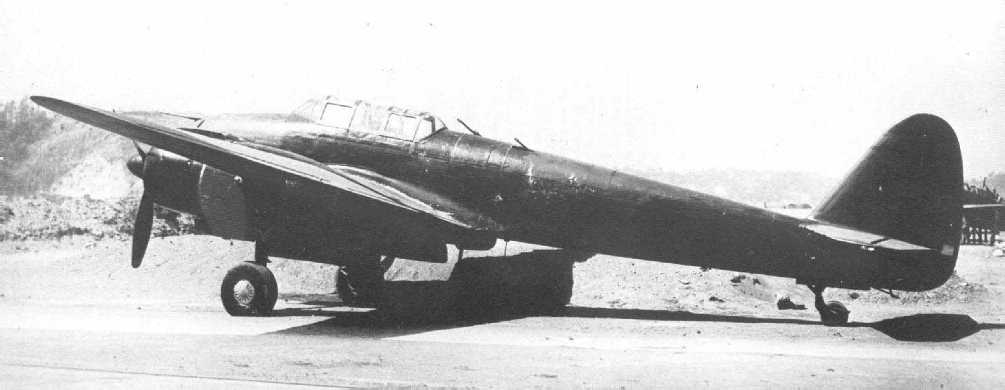
The Ki-45 was a mid-wing monoplane with pleasant lines and a crew of two, pilot and rear gunner. It had an elliptical wing platform, and rounded horizontal and vertical fins. Two 820 hp Ha-20-Otsu radial engines were installed in fairly short and stubby nacelles, which also housed the semi-retractable landing gear. The engines and nacelles turned out to be the weak point of the design. The Ha-20-Otsu was highly unreliable and the nacelles were a source of aerodynamic problems. Both performance and manoeuverability of the Ki-45 fell well short of requirements. Not without hesitation did the Army order an improved version with 1050 hp Ha-25 engines, which flew in the late summer of 1940. This at least raised performance, and hopes.
Meanwhile, Takeo Doi and his team had started on an extensive reworking of the design. Although the aircraft they were now preparing would enter service as the Ki-45-KAI, the abbreviation KAI meaning Kaizo, modified, it was in reality an almost entirely new design, with only the most superficial similarity to the original Ki-45. The cross-section of the fuselage was reduced. The wing abandoned the elliptical planform in favour of straight taper with rounded tips, and the engine nacelles were moved lower in relation to the wing and aerodunamically improved. The changes made the aircraft slightly larger, but more significantly, improved performance and made it easier to build. The Ha-25 engines were retained for the very first Ki-45-KAI aircraft, but were replaced by the more reliable Ha-102 later.
Where the Ki-45 had possesed pleasing lines conveying the general impression of a unfinished 1930s design, the Ki-45-KAI looked neat, crisp, and modern. Performance and handling were judged entirely satisfactory, and in early 1942 the Ki-45-KAI-Ko started to come off the production line, under the official designation of Type 2 Two-Seat Fighter. Armament was now two 12.7-mm Ho-103 machine guns in the nose, a 20-mm Ho-3 cannon in a ventral tunnel, and a flexible 7.92-mm Type 98 in the rear cockpit. This fell short of the firepower carried by competing twin-engined fighters, especially considering the low rate of fire of the Ho-3, but on the positive side the Ki-45 was the most manoeuverable twin-engined fighter of the war.
The operational roles of the Ki-45-KAI Toryu, which was given the recognition name “Nick” by Allied Intelligence, soon diverged from the intended bomber escort role. The type was too much at a disadvantage in combat with Allied single-engined fighters. It was, however, an effective ground attack and anti-shipping aircraft and a good interceptor. When the need for a nightfighter arose, the Toryu was the logical choice, equipped with a pair of obliquely upward firing Ho-103 machine guns or 20-mm Ho-5 cannon instead of the upper fuselage fuel tank. To save weight, the Ho-3 cannon in the ventral tunnel was often removed. By day and night, the upward-firing guns made it possible to attack from below, where a bomber’s defences were weakest.
This combat experience uses resulted in the development of adapted versions. Great confusion exists over the armament and specifications of the Ki-45 developments, but it appears that the Ki-45-KAI-Otsu was a specialized attack version, with the Ho-3 cannon replaced by a manually loaded 37-mm cannon, the Type 94. The Ki-45-KAI-Hei retained the Ho-3 cannon but omitted the fixed machine guns, to carry instead a 37-mm Ho-203 cannon in the nose. The Ho-203 fired a lighter projectile at a slightly lower muzzle velocity than the Type 94, and although automatic it fired at only 120 rpm. Such armament was unsuitable for combat against enemy fighters, but effective against ground targets or bombers. The Ki-45-KAI-Tei on the other hand adopted the 20-mm Ho-5 upward-firing guns of earlier improvised nightfighters as standard, in combination with the Ho-203 in the nose, but it still lacked radar. (A version with radar in the nose appeared near the end of the war, but probably did not see combat.) Another armament decision made in the final production runs was no longer to install the Type 98 machine gun in the aft cockpit, because it was ineffective.

While the Ki-45-KAI had been an indisputable succes, it had only been really sufficient for a short period. It had entered service in the middle of 1942, but from the second half of 1944 the Japanese needed an interceptor capable enough to provided a defence against the large, high-flying B-29. For this, the Toryu lacked the performance, although the heavy cannon of the later versions gave them more firepower than other Japanese interceptors. As it was one of the best aircraft Japan possessed for this task, an increasing number of Ki-45-KAI units was employed for home defence. A better aircraft was urgently needed.
Kawasaki had not neglected to develop such an aircraft, but it had been delayed by doctrinal doubts on the success and correct employment of a twin-engined fighter. At first, Kawasaki started (on its own initiative and without army support) on a Ki-45-II development with a better streamlined fuselage and 1,500 hp Ha-112-II radial engines. At the suggestion of the Koku Hombu, the prototypes were completed as single-seat fighters, the first with the rear cockpit simply faired over, the second and third more thoroughly redesigned and fitted with an all-round vision canopy. The Ki-96 was an excellent aircraft, with a maximum speed of 630 km/h at 9,500 m and better handling than the Ki-45-KAI. However, when it flew in September 1943, the Army had already reversed its decision on the crew arrangement, and the goal of the Ki-96 programme was reduced to providing data for the two-seat Ki-102.
The development of the Ki-102 was given a high priority. Based on the Ki-96, this was an aerodynamically highly refined aircraft, planned from the start in two basic versions. The Ki-102-Ko would be a high-altitude interceptor with turbocharged engines and a 37-mm Ho-203 cannon and two 20-mm Ho-5; this was the aircraft that was needed to combat the B-29. And the Ki-102-Otsu was to be a ground attack model, lacking the turbochargers, and with a 57-mm Ho-401 instead of the 37-mm weapon. In parallel, Kawasaki was to work on the Ki-108, which reverted to the single-seat configuration, and would be equipped with a pressure cabin for high-altitude operations.
The first Ki-102-Ko was flown in June 1944, and following successful tests it was decided to phase out Ki-45-KAI production in favour of the Ki-102. However, while the aircraft was ready, the turbochargers were not, and therefore production started in October 1944 with the Ki-102-Otsu, officially designated Army Type 4 Assault Aircraft. Although a handful of interceptor models were completed before the end of the war, none of them was ever handed over to a combat unit. The bombing of the factories reduced even the output of the Ki-102-Otsu line to only 215. The prototypes of a Ki-102-Hei nightfighter version, with radar based on the German FuG 240 and two 30-mm Ho-155 cannon, never flew; both prototypes being seriously damaged by bombing before their first flight.
The Ki-108 on the other hand did fly, but flight testing was also affected by bombing, and had not been completed at the end of the war.
Rob
One of the most daring attempts to build a twin-engined fighter was initiated by Kawasaki’s Takeo Doi in 1939. Inspired by the engine installations of high-speed racing aircraft and developments in France, he projected a fighter that would be powered by two engines, one in the nose and one in the aft fuselage, each driving its own propeller on the nose — the aft engine driving the front propeller, but means of an extension shaft passing through the hollow gearing of the front engine. By combining two liquid-cooled Ha-40 engines (the Japanese licensed version of the Daimler-Benz DB 601) and using surface cooling to reduce drag, a speed of 700 km/h was within reach.
The technical problems and complications were obvious, and the Army did not give permission to start development work until late in 1940. The combination powerplant, designated Ha-201, was tested on the bench from the end of 1942 until the middle of 1943, and the prototype fighter was finally completed in November 1943. It was given the designation Ki-64, and the allied reporting name “Rob”. On the fifth flight a fire broke out in the rear engine bay, where cooling problems had been persistent, and although the pilot made a successful emergency landing, the sole Ki-64 never flew again.
Dinah
Mitsubishi had declined to submit the Ki-39 design as a heavy fighter, but it had served as the basis for a reconnaissance aircraft, the Ki-40. However, because this did not meet the army specifications for a long-range reconnaissance aircraft, it was abandoned and replaced by the Ki-46, which entered production just before the war in the Pacific broke out. As a reconaissance aircraft, the Ki-46 was a brilliant design, an elegant, streamlined aircraft with a high performance. The Ki-46-III model of late 1942 had a maximum speed of 630 km/h at 5,800 m, powered by 1250 hp Ha-112-II radials. Allied intelligence gave this excellent aircraft, which was able to outrun fighters, the reporting name “Dinah.”
This was well above the performance of the Ki-45-KAI and stimulated interest in a fighter version. The Ki-46-III-KAI, also known as the Army Type 100 Interceptor, featured a stepped cockpit window instead of the streamlined unstepped nose of the reconnaissance version. Armament consisted of two 20-mm Ho-5 cannon and a 37-mm Ho-204, mounted between the pilot’s and observer’s cabins, and angled 70 degrees up. A few of the older Ki-46-II were converted to incerceptors in the field, with the 37-mm Type 94 cannon. However, the Ki-46 had not been designed as a fighter. It was a lightly-built aircraft optimized to cruise at high speed and altitude. As a fighter, it lacked the required rate of climb, manoeuvrability, or sturdiness for its task. A version for ground attack, the Ki-46-III Otsu, presumably would have been even more vulnerable, but only a few were completed.

An even more unwise improvisation delivered the Ki-109, a derivative of the Ki-67 Hiryu bomber. The Ki-67 was an excellent bomber, fast and very agile for its size. The Ki-109 was in the weight and performance class of a Bristol Beaufighter, although it was a considerably bigger aircraft. The intended use of turbo-supercharged engines promised to make the Ki-109 capable of intercepting the B-29. But the unsatisfactory state of development of the turbines forced the type into service without them, as the Ki-109-Ko, in November 1944. Without the turbochargers the aircraft was unable to get near enough to a B-29 to use its 75-mm Type 88 anti-aircraft cannon. Besides, this manually-loaded cannon and a 12.7-mm Ho-103 tail gun were its only armament, so that the Ki-109-Ko would have been woefully vulnerable to US escort fighters if it had encountered them. The Ki-109-Ko can only be considered a complete failure.
A much more promising Mitsubishi effort was the Ki-83, designed to meet a May 1942 requirement for a two-seat long-range fighter. The Ki-83 had simple, clean lines, with a streamlined fuselage and powerful Ha-211 turbo-supercharged engines. Armament would consist of two 20-mm and two 30-mm cannon in the nose. The aircraft was highly agile and the fastest Japanes fighter built during the war. Official performance figures included a top speed of 704 km/h at 9,000 m, but during post-war tests in the USA, using (much better quality) American fuel, it was good for 756 km/h. It hardly needs to be said that the development of the turbocharged engines was slow and plagued by problems. The fuselage and tail of the Ki-83 needed modifications too. The first prototype flew on 18 November 1944, but no production aircraft were delivered; in fact by the end of the war the emphasis had shifted to a specialized interceptor derivative, the Ki-103.

Another design that did not reach the frontline was the Ki-93. This aircraft was designed, not by a private manufacturer, but by the Army Aerotechnical Research Institute (Rikugun Koku Gijutso Kenkyujo, also known as Giken). Work on the drawings started already before the Pacific War, but in part due to changes in the tasks assigned to the aircraft, and in part to the inexperience of the Giken in aircraft design, a prototype was not flown until 8 April 1945. Like most Japanese fighters of its generation, the Ki-93 was elegantly streamlined. The six-bladed propellers of the two 2,700 hp Ha-214 radials emphasised the promise of high performance. In fact its predicted performance was good but not impressive, and the real strong points of the Ki-93 were ruggedness, extensive armour protection, and heavy armament: a 57-mm Ho-402 cannon in the nose, a 20-mm Ho-5 in each wing root, and a flexible Ho-103 in the rear cockpit. In other times it could have been a successful fighter-bomber and close-support aircraft, but in reality its first flight was also its last one, for the prototype was damaged during the landing and subsequently destroyed by bombing.
In summary, the experience of the Japanese Army with its twin-engined fighters was not a very happy one. It managed to enter the war with the Ki-45-KAI, which was a sound, versatile design, but like many Japanese designs it aged quickly and in the second half of the war it was no longer a match for the enemy. Attempts to replace it by a more modern aircraft all foundered, both for technical and for institutional reasons. The Army changed its mind on the features such an aircraft should have a few times too often, and the Japanese industry never brought to an acceptable standard of reliability the powerful, high-altitude rated engines that were so much needed.
The Japanese Navy
Lack of cooperation between the Imperial Japanese Army and Navy was one of the most serious weaknesses of the Japanese war effort. In line with the same tortuous logic that caused the Army to operate its own submarines, the Navy developed several categories of land-based aircraft, distinct from army types. For the history of the twin-engined fighter this is perhaps fortunate, as there was little room for twin-engined types on an aircraft carrier.
In June 1983, the Navy formulated a requirement for a twin-engined long-range escort fighter. At that time, of course, work on the Ki-45 was already in progress, and the Navy had kept itself informed on this project. But the specification for the “13-Shi twin-engined land-based fighter” was somewhat different, in that the Navy wanted a three-seat rather than a two-seat design, and the range requirement of 2400 km (3700 km with auxiliary fuel tanks) was well above what the Ki-45 was capable of. On the other hand, the top speed of 520 km/h was below that specified for the Ki-45, and armament requirements were almost identical. Perhaps the Navy really wanted to avoid purchasing a version of the Ki-45, for it submitted its request only to Nakajima and Mitsubishi. (Both these large aircraft manufacturers supplied aircraft to both Army and Navy, although different ones. Other manufacturers produced for only one of the services; and Kawasaki was an Army supplier.) Again, Mitsubishi declined to participate.
The Nakajima J1N became a bigger and somewhat more complex aircraft than the Ki-45, but despite Nakajima’s best efforts, it was not a very successful one. To meet the range requirement and have a sufficiently low wing loading for high agility, the type was given a wing span of 17 m, and equipped with automatic “combat flaps”. But on test flights, the maneuverability of the J1N was found to be insufficient for a fighter. The engines were to be Nakajima Sakae 14-cylinder radials, rotating in opposite directions, the upper blades moving inwards. But the modified gearing in the right-hand Sakae 22 engine reduced its power, and finally the production aircraft were equipped with two Sakae 21 engines, both turning in the same direction. The sophisticated rear defence system of the J1N was one of its most innovative elements. The cockpit fairing ended in two small remote-controlled turrets, each with a pair of 7.7-mm Type 92 Model 3 machine guns. The turrets were staggered, the second one behind and below the first one, and a sliding cover reduced their drag when not in use. Unfortunately, the complexity of this system delayed the delivery of the aircraft, and ultimately it was never perfected; the aiming system remained too slow and inaccurate. Only a small number of J1Ns were equipped with it, but meanwhile, its weight helped to reduce the performance of the J1N, which was found to be below specifications.
Tests following the first flight on 26 March 1941 revealed these and other defects, and as a result the future of the J1N became uncertain. The aircraft was considered unable to operate as a day fighter, and Navy’s carrier-based fighter, the famous A6M “Zero”, possessed an impressive range that removed the need for a dedicated escort fighter. The story of the J1N would probably have ended with its condemnation in the summer of 1942, if the Navy had not realized at that time that its land-based reconnaissance aircraft, the Mitsubishi C5M, was obsolete, and that the J1N might replace it. The result was the “Type 2 land-based reconnaissance aircraft”, or J1N1-C.
The J1N1-C lacked the fixed 20-mm cannon of the fighter prototype, but intially the pair of 7.7-mm Type 97 machine guns in the nose was retained, although it was removed from later models. The rear armament was also progressively modified, first by replacing the troublesome remote-controlled turrets by a simple flexible gun, and at the end of 1942 by installing an enormous and highly drag-inducing manually-operated turret with a 20-mm cannon, taken from the cancelled G5N heavy bomber. In the middle of 1943 a somewhat more streamlined turret was introduced, but the J1N1-C was hardly a success. It was clearly inferior to the Army’s Ki-46 reconnaissance aircraft, which began to be used also by the Navy.
The J1N was rescued from oblivion by the great enthusiasm of a Navy officer, Commander Kozono, for obliquely-firing guns. Cdr. Kozono Yasuna appears to have been rather eccentric and some of the gun installations proposed by him were useless, but his installation of oblique-firing cannon in the J1N made a qualified success out of an indifferent aircraft. The first two modifications consisted of two 20-mm Type 99-2 cannon aimed 30 degrees up, and two more 30 degrees down, all installed in the space once taken by the remote-controlled gun turrets. Matching sights were installed in the cockpit. Trials showed the value of the installation, especially for the interception of bombers at night, and the modified aircraft went into production as the J1N1-S Gekko (Moonlight). From the 301st aircraft onward, the complicated fuselage decking for the gun turrets was finally omitted, and the cannon installed in a simpler and better streamlined fuselage structure.

Armament installations varied locally, as older aircraft were modified to J1N1-S configuration, or J1N-1S were adapted by installing or removing cannon. A few came out of the factory as J1N1-Sa models with three upward-firing guns instead of two. The downward-firing cannon were often removed, as they were not very useful and the Gekko needed to be light to stand a chance of intercepting a B-29. A major step foward could have been the first installations of radar on a Japanese fighter, inspired by captured American radars, but by 1945 the Japanese industry was seriously troubled by lack of resources and the manufacturing quality of these radars was apparently poor enough to render them useless.
Overall, the J1N1-S proved to be a fairly effective nightfighter, and its victims included two dozen B-29s. Whether this really justified the existence of a separate fighter type in parallel with the Ki-45, can be seriously doubted.
| Kawasaki Ki-45-KAI-Hei | Nakajima J1N1-S | |
|---|---|---|
| Engines | Mitsubishi Ha-102 | Nakajima NK1F Sakae 21 |
| Rating | 1080 hp | 1130 hp |
| Wing Span (m) | 15.00 | 16.98 |
| Length (m) | 11.00 | 12.77 |
| Height (m) | 3.70 | 4.56 |
| Wing Area (m2) | 32.00 | 40.00 |
| Empty Weight (kg) | 3695 | 4840 |
| Loaded Weight (kg) | 5276 | 8184 |
| Max. Speed (km/h) | 547 km/h at 6000 m | 507 km/h at 5840 m |
| Climb | 5000 m in 6.12 min | 5000 m in 9.58 min |
| Ceiling (m) | ||
| Range (km) | 2000 | 3780 |
| Guns, fixed | One 37-mm Ho-203 cannon in the nose One 20-mm Ho-3 cannon in a ventral tunnel | Two 20-mm Type 99-2 firing obliquely upward Two 20-mm Type 99-2 firing obliquely downward |
| Guns, flexible | One 7.92-mm Type 98 in the rear cockpit |
The Navy imitated the Army in more than one way, for it too failed in its effort to find a modern replacement for its twin-engined fighter. The Nakajima J5N Tenrai, first flown in July 1944, had poor handling qualities and, despite the use of 1990 hp Homare 21 engines, disappointing performance. It achieved a top speed of only 597 kmh at 6,000 m. Four prototypes were completed as single-seat fighters and two as two-seaters before the inevitable cancellation. Aichi contribution a dedicated nightfighter design, the heavily armed S1A Denko, but at the end of war its prototypes had not yet been completed.
The Navy did have a bomber that appeared to be highly suited for a nightfighter conversion. The P1Y had been designed by the Yokosuka naval arsenal as a fast medium bomber for use against naval targets, capable of level attacks from altitude, dive bombing, and torpedo bombing. The P1Y was compact for a bomber, with a wing span of 20 m. It carried only only a moderate bomb load or a single torpedo, and was fast enough to outrun fighters at low level. When first reported by Allied intelligence, the type was assumed to be a fighter and accordingly given a boy’s first name as reporting name: Francis. When the aircraft was discovered to be a bomber, this could be changed to Frances without creating confusion. The potential of the type was, however, balanced by its complexity and difficult maintenance.
A number of P1Y1 bombers, powered by 1825 hp Nakajima NK9C Homare 11 radials, were modified to P1Y1-S nightfighters, equipped with a pair of obliquely upward firing 20-mm cannon in the front fuselage and a second pair in the aft fuselage. They were given the popular name Byakko (White Light). The P1Y2-S version, powered by more reliable 1850 hp Mitsubishi Kasei 25 engines, was known as Kyokko (Aurora), and was factory-produced by Kawanishi, rather than a bomber conversion. The P1Y2-S possessed an AI radar, of which the antenna array was installed on the nose. Besides two upward-firing 20-mm cannon in the aft fuselage, the P1Y2-S had a single flexible 20-mm or 13-mm weapon to defend the rear, and it retained the internal bomb bay for intruder missions.
But neither version turned out to be very useful for the Japanese. The Kyokko made its first flight in June 1944, and when it entered service the biggest threat was the B-29 bomber. Like most Japanese fighters of the period, the P1Y2-S lacked the performance to be an effective B-29 interceptor. The original bomber model had been fast, but it had been fast at low altitude, where its missions and its targets were to be found. The nightfighter conversion failed because the performance at high altitude was disappointing. In addition, we can consider that the armament of the P1Y-2S was too light and its radar probably insufficiently reliable. It is reported that most of the small number (96) of P1Y2-S nightfighters built by Kawanishi were converted back to bombers, with removal of their radar and fixed guns. The limited number of P1Y1-S conversions also failed to make an impression.
Thus the IJN’s efforts to develop twin-engined fighters produced one qualified success, the J1N1-S, and a series of failures. At the end of the war, the Japanese army could at least show a series of impressive prototypes, although to little benefit for themselves. The Navy did not even have that much to show for its efforts.
Perhaps the Japanese experiences demonstrate how much the success of the twin-engined fighter concept depended on technical advances, and especially on powerful engines. Japanese aircraft designers had to work with engines of generally lower power and inferior reliability, compared to those fielded by Japan’s enemies. As the war progressed and took a turn for the worse, the ability of the national industry to manufacture armaments of advanced technology and high quality entered a terminal decline, as it ran out of the necessary raw materials and skilled manpower. The result was that impressive prototypes were doomed to remain impressive prototypes, for Japan was unable put them into service.
Leave a Reply