RAF
As we have seen above, none of the British twin-engined fighter projects during the interbellum produced an useful combat type. Instead, single-engined two-seat fighters were in service, the last biplane representative being the Hawker Demon, a development of the Hart light Bomber. Its direct technical successor was arguably the Boulton-Paul Defiant, but there also appeared to be an operational requirement for a twin-engined, long-range fighter. It so happened that a convenient solution seemed to be around in the form of the Bristol Blenheim light bomber, an aircraft with a fairly high performance. Blenheim Mk.I bombers were already being replaced by later versions in Bomber Command, and after some debate a very simple conversion of these aircraft allowed them to be used as heavy fighters. The changes consisted of four .303 machine guns in a ventral gun pack, light armour plate for the pilot, and a gunsight (or more precisely two, a reflector sight and a ring-and-bead sight as backup). This version was known as the Blenheim Mk.IF. It also retained the simple and rather ineffective Bristol dorsal turret with a single Vickers Class K gun, and a fixed gun in the left wing.
Introduced in late 1938, this amounted to a conversion of a faintly obsolescent light bomber into an even more obsolescent heavy fighter, underpowered and undergunned. With 840 hp Mercury VIII engines and a top speed of 423 km/h at 3,050 m, the Mk.IF was no match for the Bf 110, and combat against enemy single-seat fighters clearly had to be avoided. As a day fighter, the Blenheim was best used only as a trainer, although some went to Coastal Command. (In vain, this Command pressed for the replacement of the .303 guns by two 20-mm cannon.) It was the best available candidate for conversion into a radar-equipped nightfighter, however, despite the disadvantage of reflections in the complex cockpit glazing.
The installation of radar was done in great haste. The first demonstration of the prototype AI radar set (installed in a Fairy Battle) was done in June 1939. It was quickly decided to equip 30 Blenheims, and 15 sets were delivered at the beginning of the war, to No 25 Squadron. Results were not forthcoming, because the ground control, while good enough to intercept enemy formations in daylight, was incapable of putting a nightfighter within radar range of an enemy target. Not until 1941 was an effective Ground Controlled Interception (GCI) radar available.
Meanwhile, work proceeded on a number of other designs, in fact quite a large number, and designed to a series of different specifications: F.37/35, F.18/36, F.9/37, F.11/37, F.18/37, F.22/39, F.18/40, and others. A few designs were built, and the Westland Whirlwind even briefly entered service. But the outcome of all this work was that the RAF fought the war with two twin-engined fighters, the Beaufighter and the Mosquito, which were fortunate by-products of other programmes.
There was no single cause for this state of affairs, but several important ones can be identified. Many of the first generation of twin-engined designs were intentionally kept small, to stay close to the weight and size of single-engined fighters. But this not only limited their usefulness and development potential, it also tied them to lighter engines of lower power, while wartime efficiency dictated that only a few types of the most powerful engines were mass-produced. Other designs were prepared to carry powerful cannon armament in flexible mounts, up to quadruple 20-mm cannon or a single 40-mm cannon. This resulted in aircraft that were far too big and heavy, and was tactical nonsense. Finally, first the need for high production of defensive fighters and later the excellence of the Mosquito blocked the way for a number of designs with high potential, of which the production could not be justified on grounds of industrial policy.
Sad Whirlwind
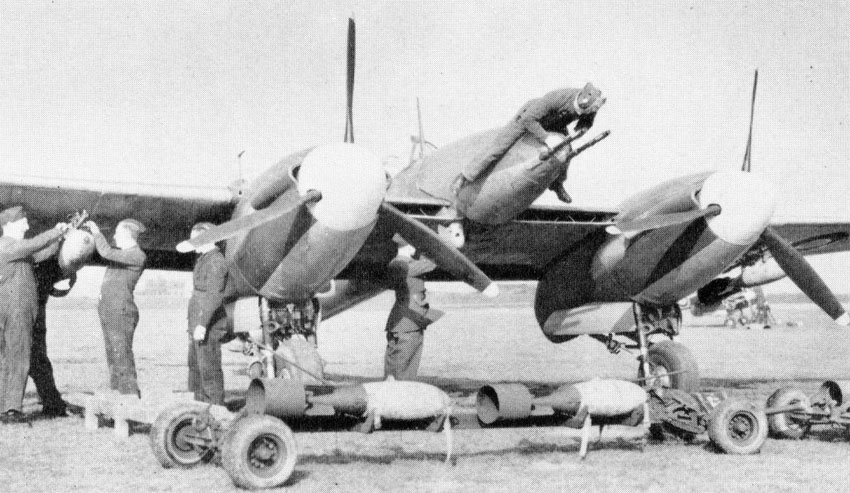
The unfortunate story of the Westland Whirlwind illustrates the point. It originated from specification F.37/35 for a fighter armed with four 20-mm or 23-mm cannon, a weapon that had been selected to arm the next generation of RAF fighters. (The Hispano had been selected, but apparently the choice between the 20-mm HS.404 or a 23-mm development of this weapon had not yet been made.) The specification left open whether the aircraft would have one or two engines, but design teams apparently felt that they needed 1600 to 1800 hp, an amount of power that could not be delivered by a single one of the engines in production at that time. The most promising of the single-engined designs was judged to be the Boulton-Paul P.88, offered in versions with a Bristol Hercules or Rolls-Royce Vulture engine, neither of which was immediately available. A (rather more elegant) offering by Bristol, the Type 153 design, also featured a Hercules radial, but Bristol also created the Type 153A, a small fighter powered by two Bristol Aquila radials. The 153A had some features in common with the Grumman XF5F-1 Skyrocket, including a fuselage nose that did not extend beyond the leading edge of the wing, radial engines in short stubby nacelles spaced closely together, and two small tailfins. The four cannon were in the bottom of the fuselage. It looked neat, but with hindsight the aerodynamics of it are rather suspect, and perhaps it is fortunate that the Type 153A was not built.
At Westland, W.E.W. Petter solved the problem by designing a small, trim fighter with two Rolls-Royce Peregrine engines, rated for 885 hp at 4,600 m. It was a highly streamlined design, and not much bigger than a Hurricane or a Spitfire. The Westland P 9 design also featured a magnesium alloy monocoque fuselage, a relatively small wing with large Fowler flaps, integral fuel tankage, radiators buried in the wing roots, and an all-round vision cockpit. The four 20-mm cannon Hispano were closely grouped together in the nose. It really was an innovative and attractive design, but in September 1936 the RAF also chose Westland because it had a less busy schedule than other manufacturers, its main other task so far being the development and production of the Lysander close-support aircraft. The order for the P 9 was confirmed in February of the following year.

There was a risk in choosing a small and relatively inexperienced company without large production facilities. The prototype flew in October 1938, but production was not expected before June 1940; the schedule continued to slip and the first operational squadron was only equipped in December 1940. Even in the first production aircraft many modifications were made, which confirmed the RAF’s fears that Westland was not capable of mass-producing a modern fighter. The company defended itself by arguing that the Whirlwind’s engine and handling faults were not worse than those encountered by most fighter prototypes, which was probably true. But Westland was too small to solve them quickly, the RAF was losing confidence, and Rolls-Royce gave the Peregrine a low priority. In August 1939 staff officers were already considering the replacement of the F.37/35 by a new design. There was nothing wrong with the performance of the aircraft, which at low altitude was faster than a Hurricane or Spitfire, and highly manoeuverable. Its misfortune was that because of all the delay, it entered service at a time when other single and twin-engined fighters were already being adapted to the same missions, and in many ways showing themselves more suitable.
And the choice for the Peregrine engine had been a fundamental error. About 20% less powerful than the Merlin, this engine was used by no other aircraft, and it was soon obvious that the war required Rolls-Royce to concentrate its effort on a few much-needed engines, each the most powerful in their class. Continued Peregrine production was only possible by building fewer Merlins, and because of reduced efficiency the exchange would be at a rate of perhaps two to one, meaning that one Whirlwind would cost the engines for four Spitfires or Hurricanes. Or, alternatively, by postponing the production of the much-needed Vulture or Griffon, which was also out of the question. Therefore, when Rolls-Royce stated that these were the options from which a choice could be made, the fate of the Whirlwind was sealed. To be fair to Westland, Bristol’s choice for the Aquila radial, another small engine, was not any better, and Supermarine suggested to use the doomed Rolls-Royce Goshawk or even the Hispano-Suiza 12Y in its Type 313. All twin-engined offerings to F.37/35 suffered from the same problem.
Anyway, in May 1940, months before the fighter even entered service, it was decided that Peregrine production would end in December. Therefore production of the Whirlwind would have to be stopped after only 114 had been delivered. The type continued in service until December 1943, mainly in the fighter-bomber role with a 500 lb bomb under each wing. With this relatively modest bombload the Whirlwind handled well, and the cannon were useful for strafing.
The installation of the Merlin might have salvaged the concept, but at the time Westland rejected this. The airframe was too small to take a bigger engine. (Later, Petter admitted that it would have been better to design the aircraft around two Merlins from the start.) Westland proposed to cure the main faults of the Whirlwind in a Mk.II version, which would have a larger internal fuel capacity, 120 instead of 60 rounds per cannon, and further developed Peregrine engines – but Rolls-Royce poured scorn on that idea. Another alternative suggested by Westland was the installation of American radial engines, perhaps the R-1830 or R-1820. The RAF had already lost interest in the Whirlwind, so these were dead ends.
Size matters
The twin-engined fighter that would do most to replace the Whirlwind was born out of a very different project. In October 1938, the first flight was recorded of the Beaufort, a twin-engined torpedo-bomber that would have a useful but troubled service life. Within the next few days, Bristol proposed the Type 156, a fairly straightforward development that would retain the wings and tail of the Beaufort, with a new front fuselage, and more powerful Hercules radials replacing the Taurus engines of the Beaufort. Four cannon would be installed in the bottom of the new front fuselage. (After the first 50 aircraft, six .303 wing guns were added.) Bristol predicted a top speed of 580 km/h at 4,600 m. And crucially, it indicated that this aircraft could be available early in 1940, even calculating that it would be able to produce 100 of them before the end of 1939. The idea was accepted, and specification F.17/39 was written around Bristol’s design.
The story is told that W.E.W. Petter was invited to have a look at the mock-up of the competing design, and commented that it was “far too large, especially the fuselage.” To which Bristol’s designer Frise replied that in two years time, such size would be necessary – and he was right. Size saved the Beaufighter, as it would be called, when the Whirlwind was cancelled. Because of its size, it had much more development potential, and unlike the Whirlwind, could do things no single-engined fighter was capable of. The pugnaciously ugly Beaufighter was an aircraft the RAF refused to do without, even when concerns about delivery and performance reached the alarm level.
It soon became clear that the Hercules VISM engine, for which the original performance estimates had been made, would not be ready for some time, and that the first production aircraft would have the less powerful Hercules II or III. The optimism of early production schedules could not be maintained either; the first prototype flew in July 1939 and the first production examples reached operation squadron in September 1940. Three squadrons were fully equipped with Beaufighters before the first Whirlwind squadron became operational, but this had been achieved by skipping final testing stages, and as consequence the serviceability of these aircraft was low. Especially the cannon caused a lot of problems, because the Hispano demanded a very stiff mounting. Early Beaufighters carried their total of 240 rounds per cannon in smaller drums, and the hapless observer had to exchange these heavy objects, groping around in a cluttered and dark fuselage. After much delay, a belt feed mechanism was developed and installed.
Tests by the A&AEE of the first four prototypes, with different engines, revealed top speeds between 539 km/h and 483 km/h, considerably inferior to the Whirlwind and a cause for serious concern. However, the Beaufighter was ideally suited as a nightfighter, because there was room in the fuselage for radar and a radar operator, and was also eagerly awaited by Coastal Command. The Mk.IC version for Coastal Command had extra fuel tankage instead of the 7.7-mm wing guns, giving it a range of 2900 km.
But performance really had to be improved. With Hercules III engines, the top speed of a production Mk.IF was 520 km/h at 4,400 m; with Hercules X or XI engines this was raised to 539 km/h at 4,700 m. Concern about Hercules engine production lead to the Beaufighter Mk.IIF version powered by Merlin XX engines, which during tests gave this model a better high altitude performance, 534 km/h being reached at 9,150 m. But these good results were not reproduced on production aircraft, and in addition the different shape of the engine nacelles created aerodynamic problems. The 1,670 hp Hercules VI or XVI, when finally available, was installed in the Beaufighter Mk.VI, but the performance improvement with the new engines was disappointing.
More hopes were raised by the prospect of installing Griffon engines, or entirely redesigning the fuselage to reduce drag. Because of wartime production pressures these projects were not pursued, and the introduction of the superior nightfighter Mosquitoes in mid-1942 removed much of the need for a faster Beaufighter. From then on the Beaufighter was gradually phased out as a nightfighter, although Fighter Command did not release the last ones until June 1944. Four USAAF squadrons, operating in the Mediterranean, were also equipped with nightfighter “Beaus”.

The Beaufighter then primarily evolved into a highly successful strike fighter. It had generally good handling characteristics, but early “Beaus” suffered from longitudinal instability, and the Mk.VI would introduce a tailplane with strong dihedral to improve stability at the cost of some loss in manoeuvrability. The heavier TF Mk.X also needed a large addition to the dorsal fin. As a daylight fighter the aircraft was not a great success, as it was inferior in speed and manoeuverability to the Bf 110. But it was an immensely strong, rugged aircraft, capable of flying long patrol missions and delivering a heavy war load. It was an ideal aircraft for interdiction and anti-shipping missions.
Coastal Command took almost all of the Beaufighter Mk.X production. The Beaufighter was perfectly suited to attack the German convoys or U-boats in the North Sea and the Bay of Biscay, with their heavily armed escorts. While some operated as fighters, others carried bombs or eight rockets under the outer wings. The TF models, also known as “Torbeau”, carried a torpedo, fitted with a “Mono Air Tail” to stabilize it in the air and extend its range of allowable launching conditions. Thus the development of the aircraft had gone full circle: Originally derived from a torpedo-bomber, the Beaufighter had now itself become a very successful torpedo launcher.
| Westland Whirlwind Mk.I | Bristol Beaufighter TF Mk.X | |
|---|---|---|
| Engines | Rolls-Royce Peregrine | Bristol Hercules XVII |
| Power | 2 x 885 hp | 2 x 1735 hp |
| Wing Span (m) | 13.72 | 17.64 |
| Length (m) | 9.83 | 12.71 |
| Height (m) | 4.83 | |
| Wing Area (m2) | 23.22 | 47.13 |
| Empty Weight (kg) | 3768 | 7082 |
| Loaded Weight (kg) | 5175 | 11441 |
| Max. Speed (km/h) | 570 km/h at 4817 m 488 km/h at sea level | 499 km/h at sea level |
| Climb | 4570 m in 5 min 42 sec | 1525 m in 3 min 30 sec |
| Ceiling (m) | 9240 | 4575 |
| Range (km) | 2367 | |
| Guns, fixed | 4 x 20 mm Hispano | 4 x 20 mm Hispano |
| Guns, flexible | 1 x 7.7 mm Vickers K, often replaced by a 7.7 mm Browning | |
| External load | Two 250 lb or 500lb bombs | One torpedo, or eight rockets with 25 lb AP or 60 lb HE warheads, or two 250 lb bombs |
F.9/37
One of the neatest of the twin-engined fighters was built to Specification F.9/37, which in turn was inspired on work by Gloster to earlier specifications for a two-seat fighter, armed with a dorsal turret. Originally this required a twin-engined fighter with a fixed nose armament of two 20-mm cannon, installed to fire slightly upwards at the so-called ‘no-allowance angle’, as well as a retractable four-gun dorsal turret. But before Gloster’s G.39 took the air in April 1939, the dorsal turret had been abandoned. Instead, three extra cannon were to be installed in the aft fuselage; because of their no-allowance trajectory they were aimed a few degrees upwards, firing over the head of the pilot. With the original 1,050 hp Taurus T-S(a) radials the G.39 demonstrated a speed of 579 km/h at 4,600 m, but these engines were troublesome and still about a year away from reaching maturity. With 900 hp Taurus T-S(a)3 engines the speed dropped to 534 km/h, and with 880 hp Peregrine in-line engines the second prototype attained 531 km/h.
The G.39 was a neat and manoeuverable aircraft, but it was considered too small for development, and the late change in armament had left it with a center of gravity problem. For some time the delay in the development of the Beaufighter, and the downward revisions of its performance figures, appeared to create an opportunity for the G.39. However, the Taurus and Peregrine engines were non-starters. In the spring of 1940 Gloster began work, at a suggestion from the Ministry of Aircraft Production, on a development with two Merlin XX engines. Called the ‘Reaper’, this was to carry four 20-mm cannon and eight machineguns in its single-seat version, and four cannon in its two-seat version. At the end of 1940 it was judged to be the best night fighter design that could be expected. However, Gloster was already engaged in the development of jet fighters, and chief designer George Carter warned that he did not have sufficient design staff to develop both the Reaper and a jet fighter. Furthermore, it would take at least 18 months before the aircraft could enter service. With the Mosquito available to take on the night fighter role, the Reaper design never progressed beyond the drawing board.
Wooden Wonder
The best of the British wartime twin-engined fighters was the de Havilland Mosquito. While this originated as a fast unarmed bomber, its potential as a fighter was obvious. It was, in fact, hard to decide whether the Mosquito was most desirable as a reconnaissance aircraft, a bomber, or a fighter; an uncertainity that created some problems with the organisation of the early production runs.
This is not the place to repeat the full history of the development of the Mosquito bomber. When the first order for fifty aircraft was placed on March 1940, this included only bomber and reconnaissance models. The project was shelved a few months later when Lord Beaverbrook reorganised aircraft production to concentrate it on the most urgently needed types only. Work on the Mosquito, never really halted, was officially restarted in July; and in that month de Havilland also received instructions to complete one of the prototypes as a fighter, with four 20-mm Hispano cannon in the belly and four 7.7-mm Browning machine guns in the nose. A contract for fighters, to specification F.21/40, followed in November, also the month in which the first prototype made its first flight. At that time, there was still discussion about the final role of the type, and a long-range day fighter version to protect convoys against German bombers was considered.
The Mosquito was, famously, built from wood. In a way, the Mosquito preceded modern trends in aircraft design, where increasing use is made of composite materials, often sandwiched around a foam core. Wood is a natural composite, consisting of cellulose fiber in a lignin matrix. For the fuselage, de Havilland opted for a sandwich consisting of skins of birch plywood with a balsa filler, this structure being three times as a strong as a plywood panel without a balsa core. The fuselage halves where glued together over a concrete mould, each plywood skin consisting of three layers 1.5 to 2 mm thick, arranged with the grain of the layers of wood at 45 degrees to each other. The wings had wooden box spars (consisting of laminated spruce flanges and plywood webs), spruce stringers, and plywood skins.
Important advantages of such a structure were that it needed a relatively small amount of light alloys (although the required high-quality wood was not that easy to find) and that it allowed woodworking shops to take part in the war effort. Another important advantage of plywood was that it could be given a very smooth finish, reducing drag. Close-cowled Merlin engines, radiators buried in the wing roots, careful design of the propellor hubs, and great attention to the details of streamlining resulted in an excellent performance: The first prototype recorded a top speed of 624 km/h at 6,700 m. For about two and a half years the Mosquito could be said to be the fastest aircraft in operational service, also thanks to new versions of the Merlin engine.
This level of performance, in combination with initial doubts about the concept of an unarmed bomber, resulted in a decision in the summer of 1940 to give the fighter version a higher priority than the bomber. Official vacillation about the role of the first Mosquito production aircraft made de Havilland’s work more difficult. While there was much commonality between fighter and bomber models in the fuselage structure (of course a nosecone with gun mounts replaced the transparent nose cone of the bomber version), the fighter model had a different, stronger wing, to take the higher loads of combat manoeuvering. It also had an armoured glass windscreen. The Mk.II fighter version finally flew its operational mission at the end of April 1942 — about a month ahead of the first operational use of the bomber model.
These fighters were F Mk.II models, most of them operating as NF Mk.II nightfighters with AI Mk.IV or Mk.V radar. They were much faster than the Beaufighters they replaced, and had a higher service ceiling, better handling and greater manoeuverability. Armament consisted of four 20-mm cannon in the belly and and four 7.7-mm machine guns in the nose. The aircraft was soon sent on offensive missions as well, stripped of its radar and equipped with extra fuel tanks, that allowed it to range deep over Germany. Later this “Intruder” role passed to the FB.VI, which could carry 1,000 lb of bombs in an internal bomb bay.
The number of roles of the fighter Mosquito soon expanded. Nightfighter Mosquitoes escorted RAF bombers into Germany, taking an increasingly heavy toll of the German Nachtjagd. Conventional escort operations were accompanied by Flower intruder operations that targeted German fighter bases, while on Mahmoud missions the British nightfighters deliberately offered themselves as bait, in the expectation of turning the tables on any attacker. Ranger missions were flown over German-held territory in day and night, looking for targets of opportunity. Instep patrols over the Bay of Biscay and the Western Approaches targeted German long-range fighters and other aircraft over the travelling routes of the German submarines. In the 2nd Tactical Air Force, fighter-bomber Mosquitoes replaced light and medium bombers, making pin-point raids on selected targets and providing air support for the invasion forces after D-Day. In Coastal Command, Mosquitos flew anti-shipping missions over the Atlantic ocean and the Norwegian coast. And in June 1944, two Mosquito nightfighter squadrons were diverted to the interception of V-1s at night.
To cope with a wide range of tasks and increasing demands on the aircraft, the Mosquito was repeatedly upgraded, but due to the high demand for the type, older models had to serve until worn out, or were modified to bring them up to the most recent standards. In the nightfighter line, the NF Mk.II with Merlin 21 engines and AI Mk.IV or Mk.V radar (466 completed) was followed, in January 1943, by the NF Mk.XII with AI Mk.VIII radar. The latter was a centimetric radar set, giving much better results than the older radars; a number of Mk.II models were converted to Mk.XIIs. As the new radar was in a radome on the nose, the 7.7-mm machine guns were removed. The similar NF.XVII was equipped with the AI Mk.X radar, alias SCR 720, a development of the British centrimetric radar produced in the USA. The NF.XIII of February 1944 was a new-built model that combined the AI Mk.VIII with the airframe of the FB.VI, which incorporated outer wing fuel tanks, and an internal bomb bay for intruder missions. The engine remained the Merlin 21 or 23, but fifty NF.XIII were equipped with nitrous oxide injection to boost their high-altitude performance for short periods — a speed gain of 75 km/h was measured at 6100 m.
The NF.XV, which turned out to be superfluous, was a highly specialised high-altitude model with extended wing tips, only four 7.7-mm Browning machine guns as armament, and Merlin engines with two-stage superchargers; only four Mk.IIs were converted to this standard, which boasted a service ceiling of 13,595 m. The NF.XIX of April 1944 had the airframe of the Mk.XIII, more powerful Merlin 25 engines, and could carry either AI MK.VIII or Mk.X in an “universal” nose radome. The final wartime nightfighter model, the NF.30, was a derivative of the NF.XIX with 70-series Merlin engines with two-stage superchargers; this gave a much better high-altitude performance with top speed raised from 595 km/h at 4270 m to 682 km/h at 8,075 m. It entered service in the spring of 1944.
The fighter-bomber models were an offshoot from the early success of the fighter models. The FB Mk.VI was essentially a derivative of the NF.II with the ability to carry bombs, both internally (in a small bomb bay aft of the cannon) and externally (under the wings). From October 1943 onwards, the aircraft could also carry eight rocket projectiles under the wings. The success was so great that ultimately, one third of the Mosquito production run consisted of fighter-bomber versions. This was helped because the fighter-bomber model was also built in Canada (the main production model being the Mk.26, with Packard Merlin engines) and in Australia as the Mk.40. For the anti-tank role, a small number of FB.XVIII ‘Tsetse’ were produced, armed with the powerful 57-mm Molins cannon. But ultimately the RAF had misgivings about the usefulness of this type and gave the aircraft to Coastal Command for anti-shipping missions.
The Mosquito was a great success as a nightfighter and a fighter-bomber, clearly superior to the Ju 88, Bf 110 or Me 410. But it was unwise for Mosquito crews to engage in combat with enemy single-engined day fighters, if they could avoid it. The Mosquito was fast but it could not match a Fw 190 or Bf 109 in manoeuverability or rate of climb. While realizing the maximum of the potential of the twin-engined type for the period, the Mosquito had sacrificed the ability to fly the missions of a single-engine fighter. That probably was an unavoidable choice, and the war potential of the Mosquito proved that it was a good one.
| Mosquito FB.VI | Mosquito NF Mk.XIII | Mosquito NF Mk.XXX | |
|---|---|---|---|
| Engines | Rolls-Royce Merlin 21 | Rolls-Royce Merlin 21 | Rolls-Royce Merlin 76 |
| Power | 2 x 1300 hp | 2 x 1300 hp | 2 x 1711 hp |
| Wing Span (m) | 16.51 | 16.51 | 16.51 |
| Length (m) | 12.34 | 12.47 | 12.64 |
| Height (m) | 4.65 | 4.65 | 4.65 |
| Wing Area (m2) | 41.81 | 41.81 | 41.81 |
| Empty Weight (kg) | 6227 | 6489 | 6875 |
| Loaded Weight (kg) | 9843 | 9072 | 9798 |
| Max. Speed (km/h) | 608 km/h at 4025 m | 595 km/h at 4270 m | 682 km/h at 8075 m 544 km/h at sea level |
| Climb | 9.50 m/sec | 4570 m in 6 min 45 sec | 11.4 m/sec |
| Ceiling (m) | |||
| Range (km) | 1803 | 2993 | 1900 |
| Guns, fixed | 4 x 20 mm Hispano 4 x 7.7 mm Browning | 4 x 20 mm Hispano | 4 x 20 mm Hispano |
| Bomb load | 2 x 500 lb bombs (series 1 aircraft, 250 lb) |
Failed Efforts
In the Beaufighter and Mosquito, the RAF had two of the most successful twin-engined fighters of the period. Curiously enough, both were a side product of bomber development, although before and during the war there were many other efforts to develop twin-engined fighters. Of the resulting designs some had a high potential but were abandoned because the types in service already met the operational need, while others were embarrasingly misguided.
Specification F.18/37 (actually issued in March 1938) called for a high-speed single-seat fighter, with a top speed not less than 400 mph at 15,000 ft, and an armament of twelve Browning .303 machine guns or more. The Bristol, Gloster and Hawker submissions were single-engined, but Supermarine offered twin-engine designs. It argued that for this category of aircraft, a twin-engined type could actually be smaller than a single-engined type, and it offered a better forward view and (with airscrews rotating in opposite directions) better handling. The Type 324 and 325 both featured a wing of elliptical platform, only 20% larger than that of a Spitfire, and a slender fuselage with a short nose. Guns were installed in the outer wing panels. The Type 324 had its engines installed as tractor engines, while the 325 had pusher engines; in both case there was a choice between Merlin V-12s or Taurus radials. The Supermarine offerings lost out to the Hawker design (which became the Vulture-powered Tornado and the Sabre-powered Typhoon) because the Air Staff saw little advantage in the twin-engined layout.
But Supermarine’s design was given a second chance, although not without doubts, when the Air Staff decided to switch to six-cannon armament. The resulting Supermarine Type 327 was a tractor design with six cannon installed very closely together in the wing roots, and a preference for the Merlin engine. A mock-up of the 327 was built, but there was a good deal of skepticism on the practicality of this design. Supermarine could not be expected to develop the 327 quickly, and there were already three twin-engined fighters under development. It was decided to discontinue this project.
Other efforts to develop a twin-engined fighter followed a rather more complex storyline, with rapidly evolving specifications reflecting that the ideas on this subject were far from frozen. Specification F.6/39, issued in April 1939, called for a powerful “fixed gun fighter”, mounting four 20-mm or two 40-mm cannon. But F.22/39 of September imagined an aircraft with a 40-mm cannon in a nose turret, powered by two Griffon engines, and capable of at least 400 mph at 20,000 ft. The latter specification morphed into F.16/40 for a “fixed cannon gun fighter”, basically the F.22/39 modified to carry eight 20-mm cannon fixed to fire forward, with 200 rounds per gun. The final iteration of the specification was F.7/41, which converted the aircraft into a high-altitude fighter with a pressure cabin, reaching its top speed of at least 415 mph at 33,000 ft, powered by two Merlin 61 engines, and with six cannon with 120 rounds each.
The unfortunate recipient of this bewildering series of specifications was Vickers, which mounted a six-year effort that resulted in one completed prototype and very little flying. However, it at least partially had itself to blame. When F.6/39 was issued, the design team of Rex Pierson drew the RAF’s attention to its Type 414, designed to carry a Vickers S 40-mm cannon in the nose, and a predictor fire control system operated by a gunner who sat next to the pilot. (A concept similar to the Bell FM-1 Airacuda.) The gunner would aim through a sight, and his input would be fed into a predictor unit, through flexible shafts and photo-electric units that would make corrections for the own speed and height. The predictor unit would aim the nose turret, which allowed for 45 degrees of elevation, 5 degrees of depression, and 20 degrees of aim to the side. It was this Vickers design that triggered the issue of F.22/39, while F.6/39 was cancelled.
In April 1940, following an inquiry on the possible installation of fixed guns, Vickers offered the Type 420, with eight 20-mm or two 40-mm cannon in its nose. The fuselage was redesigned to reduce the cross section, and the second crew member now set behind the pilot, near the trailing edge of the wing. The elliptical wings were swept slightly forward, giving the design an unusual shape. The RAF issued F.16/40 to cover the Type 420, and ordered both the F.22/39 and F.16/40 designs to be built. Early in 1941, the RAF had apparently lost interest in both aircraft, which were rather too large and heavy to fill the twin-engined fighter role effectively. Vickers countered by offering a high-altitude version with Merlin engines and a pressurised fuselage, claiming that it would be easy to seal and pressurise the circular-cross section, stressed-skin fuselage. The RAF duly cancelled the F.22/39 aircraft, and at the end of the year issued F.7/41 to cover the new Type 432. This was to carry a pilot only, confined in a primitive pressure cabin, 5 m long and 1.4 m in diameter. This could be entered through a heavy circular door installed in the fuselage; but the transparent canopy, a round blister, could also be opened. The six cannon were to be installed in a ventral pack under the whale-shaped fuselage.
Nicknamed “Tin Mossie” because of its superficial similarity with the Mosquito, the aircraft finally made its first flight on 24 December 1942. Unfortunately, the type 432 was beset with aerodynamic and handling problems, engine cooling problems, and unsatisfactory performance. By the autumn of 1943, the 432 was due to be cancelled, but in a last confusing iteration, Vickers proposed to use the aircraft to test an installation of a 40-mm cannon with a predictor sight. It is possible that some work on this was done before the aircraft was finally scrapped, but it was not flown in this configuration.

The conversion of the Vickers project to a high-altitude fighter had been prompted by fears that German bombers would switch to operations at very high altitude. The development of pressure cabins and turbochargers made such operations technically feasible, justifying the development of a fighter to counter this treat, which in the end did not materialize (except for a small number of high-altitude reconnaissance aircraft). In the summer of 1941, Specifation F.4/40 for a single-seat high altitude fighter was released, stipulating a design service ceiling of no less than 45,000 ft. The bulk and weight of the pressurised cabin, and the reduced power of the suggested Merlin RM.6SM engines at such high altitudes, made a twin-engined aircraft the most practical solution, but a single-engined design was also possible.
General Aircraft, the only manufacturer with practical experience in the design of pressure cabins, suggested the GAL.46, an elegant design with twin tail fins and large wing root fairings, blending into a slim fuselage. However, General Aircraft lacked any experience in fighter design. Westland, on the other hand, suggested an larger extrapolation of the Whirlwind with Griffon or Merlin engines and a long-span wing with a high aspect ratio. A single-engined offering by Hawker, based on a Typhoon with a Sabre engine and two-stage supercharging, was actually liked best; but Westland won the contract. The Westland F.4/40 was ordered as the Welkin, in Mk.I version as a single-seat day fighter and Mk.II as two-seat nightfighter, both with Merlin engines, with Griffon engines planned for a later version. When F.7/41 was issued, the Welkin design was modified to meet this specification as well.
The Welkin was the biggest single-seat fighter of its time. It looked good, with the angular contours of the wing and tail surfaces complemented by a streamlined fuselage and closely-cowled Merlin 61 engines. The pilot, seated well forward, enjoyed an excellent forward view. The first flight was made on 1 November 1942, after a creditably short development period. To avoid leakage problems with pushrods or cables moving through the pressure wall of the cabin, many of the systems were electrically controlled. This turned out to be something of a maintenance nightmare, while serious problems with the engines and propellers would be a recurrent theme during testing. The Welkin also needed some aerodynamic modifications need cure handling deficiencies. However, what fundamentally handicapped the Welkin was the relatively thick section of its wing, a 21% thickness/chord ratio at the root tapering down to 15% at the tip, which gave it a critical Mach number of 0.74, with severe pitch oscillation already occurring at Mach 0.68. This was not acceptable for a good high-altitude fighter, but fortunately the operational needs could be met by other aircraft. Although 103 Welkins were completed, most were put in storage, and the Welkin never equipped a squadron.
Leave a Reply