
The American Effort
Whatever limitations the Soviet twin-engined fighters had, from a tactical point of view all of them made some sense, with perhaps the exception of the Yakovlev I-29. The same cannot be said of the US efforts in the same direction. Perhaps the operational experience of Russian participants in the Spanish Civil War played a role in keeping the wilder ambitions of Soviet designers in check. However, one gets the feeling that many more outlandish concepts were studied in the USA for the simple reason that with all the technology available there, much more was possible. Yet these white elephants would not have been created without the blessing of the air force.
Bell FM-1 Airacuda
In the early 1930s, the Army Air Corps made conservative choices in fighter design. In 1934 it adopted its first monoplane fighter, the Boeing P-26. This not only had wire-braced wings and fixed landing gear, it had the dimensions and the weight of a traditional biplane fighter. Even by the standards of the mid-1930s it was small, light, and powered by a light engine. The P-26 was too slow to catch modern bombers and too weakly armed to shoot them down.
In 1934 the Materiel Division initiated a study of a heavy “multiplace fighter” design, which was centred around the concept of a Martin B-10 bomber modified to operate as escort fighter, or as the documents quaintly put it, “a bombardment accompanying weapon”. The study mainly demonstrated that this was a poor concept. Adding extra armament to a B-10 airframe and reinforcing it for combat manoeuvring would make it slower than the bombers it was intended to escort. Besides, the basic design was already ageing rapidly.
This could have been the end of it, but the designer Bob Woods had been considering a much more advanced multiplace fighter, and Larry Bell successfully promoted it to the Air Corps. The key elements of the Bell Aircraft Corporation offer were the new Browning-designed 37-mm cannon and the Allison V-1710 V-12 engine. The Allison engine, in its turbosupercharged form, offered high performance at the expected cruising altitudes of long-range bombers. The cannon would allow enemy bombers to be destroyed from a safe distance, well out of reach of their defensive armament. For this purpose, they would be installed on powered mounts, and aimed by an automatic fire control system. Specification X-604 was written around this concept, and Lockheed was invited to prepare a competing design. But it was the Bell aircraft that won the order, by a narrow margin.

The aircraft was given the designation FM-1 for Fighter, Multiplace, at a time when single-seat fighters were still given P designations for Pursuit. Several layouts had been studied, with up to four cannon, but the Bell FM-1 Airacuda emerged with two V-1710 engines driving pusher propellers, in large nacelles that each also contained the powered gun mounts and gunner’s stations in front. The main role of the gunners was to feed the cannon, for the weapon that was used did not have the belt feed that characterised the M4 cannon as later used in the P-39. A .30 Browning machine gun was installed co-axially with the cannon to aid in aiming, but visual gunlaying from the nacelle would still have been poor, also because the view from them was rather restricted.
Instead, the guns were aimed from a station in the main fuselage. The fire control system was based on systems developed for laying anti-aircraft guns, and was quite sophisticated for the time. Inputs from an optical sight and a rangefinder were processed by a computing unit, and then the aiming parameters were electrically signalled to the nacelles. There, hydraulic servo controls aimed the guns as desired. The movement was restricted to a 30 degree cone in front of the aircraft, so the Airacuda was to fly behind the enemy bomber formation, supposedly picking off its targets one by one.
All this came at a cost, and the XFM-1 prototype, flown in July 1937, possessed a 21.33 m wing span, an empty weight of 6,200 kg, and room for a crew of five. With V-1710-13 engines that delivered only 1,090 hp each, considerably less than had been hoped for, the top speed was 434 km/h at 6,100 m, well below the original specification. Nevertheless, the prototype was followed by 13 service test aircraft under the designation YFM-1 — actually eight YFM-1 aircraft with turbosupercharged V-1710-23 engines, three YFM-1A with turbosupercharged engines and nosewheel landing gear, and two YFM-1B with tail-dragger landing gear and V-1710-41 engines without the turbo. These aircraft had, besides the cannon and their co-axial .30 machine guns, two hatches in the sides of the aft fuselage mounting .50 Browning machine guns, a retractable dorsal turret mounting a .30, and a belly fairing with a .30 at the end.
The YFM-1s were very little flown, totalling less than 500 flying hours between them before the survivors were disposed of. They were highly specialized aircraft, with a dubious operational role against a threat that turned out to be non-existent; the continental USA was well beyond the range of enemy bomber fleets. Their real value was that of an exercise in design and engineering of advanced combat aircraft.
Skyrocket
Not only in the army, but also in the navy, brains were kept busy considering the defense of the USA against enemy bombers. The naval mind was much concerned with coastline targets, naval bases, and ships, which could be attacked with little warning. To effectively defend such targets against attack by modern high-altitude bombers, a fighter needed heavy armament and a very high climb rate. In 1935, it appeared to the Bureau of Aeronautics (BuAer) that the power of the available engines would not allow single-engined fighters to meet the requirements of this role, even allowing for engines then under development. And carrier fighters, of course, would be handicapped by their need for extra structural strength and arrester gear.
The result of this line of thought was, in 1935, BuAer Proposal SD-24D for a fast-climbing naval interceptor, followed in 1938 by Specification SD112-14. The Navy’s emphasis on climb and the requirement to operate the aircraft from carriers of course ruled out elephantine concepts such as the FM-1. What it wanted was a small, twin-engined, single-seat interceptor with excellent performance. The design that the Navy picked to be built and flown was the Grumman G-34, and the prototype was given the official designation XF5F-1.
This was the smallest aircraft that could be built around two powerful radial engines. To be able to install the engines as close together as possible, the fuselage of the XF5F-1 was given a small and short nose, that allowed for closely spaced propellers; and after wind tunnel trials it was cut back further, so that it did not even extend as far as the leading edge of the wing. The engine installation not only reduced wing span, it reduced asymmetric effects when flying on one engine, and allowed for smaller tail fins. The downside of this configuration was that much of the aircraft was now behind the center of lift of the wing; the engines themselves contributed only about a third of the total empty mass. This made it difficult to get the center of gravity of the XF5F-1 right. It also gave the aircraft unique looks, with a noseless fuselage, radial engines in stubby nacelles, and angular twin tail fins.
The engines were a problem. The two options were the Wright Cyclone, which had its cylinders arranged in single row, and the Pratt & Whitney Twin Wasp, a two-row design. Their respective designations R-1830 and R-1820 indicate that the engines were close in internal volume, as they were in weight and power; but the Pratt & Whitney design had a smaller diameter and offered less drag. The Navy would have preferred it, but the Wright engine was more readily available. The Navy instructed Grumman to build a full-scale wind tunnel model with two different engine nacelles, and finally ordered the prototype with the R-1820 Cyclone. The XF5F-1 had counter-rotating propellers, which would especially improve handling during the take-off and landing phases that are so critical for a carrier-borne aircraft.
Armament choices also created difficulties. The Navy wanted a more effective weapon than the .50 machine gun, but no suitable gun was being manufactured in the USA. A test batch of four Danish 23-mm Madsen cannon had been ordered in 1937, and it was planned to install two of these weapons in the F5F; but this was never done. Ground tests with the Madsen cannon revealed a low rate of fire and poor reliability, and the Navy lost interest. Instead two .50 and two .30 guns were installed in the nose; the centreline installation still offered clear benefits for gun aiming but the aircraft no longer had a firepower advantage over modern single-engined fighters. Perhaps in compensation, the Navy asked Grumman to provide for the carriage of 20 anti-aircraft bombs, internally in the wing. These 2.4 kg weapons were to be dropped on top of an enemy formation, a concept that was widespread in the late 1930s but was sadly deficient in operational value.
The XF5F-1 took to the air on the first of April 1940. Tests were relatively trouble-free, although the unusual configuration caused some aerodynamic problems. These resulted in repeated modifications during a long test programme. The new fighter was about 80 km/h faster than the single-engined F4F Wildcat and possessed an impressive rate of climb, which resulted in the type being dubbed the Skyrocket. Nevertheless, the F5F would never enter production, and this was quite obvious by the end of 1940. Hence, in January 1941, Grumman asked for the termination of the program.
The reality was that, like other small twin-engined fighters, the Skyrocket lacked development potential and a future. The weight growth of the prototype was already a concern before it first flew, and there was little room for the additional equipment needed to upgrade it to a combat type. Contrary to earlier expectations, engines were appearing that had twice the power of the R-1820. The Navy was already awaiting Vought’s F4U, which was single-engined, but about as big and heavier than the XF5F-1, and carried heavier armament. Similar to the contemporary Westland Whirlwind, the Skyrocket was a technological dead end, overtaken by the rapid developments of the 1940s.

Nevertheless the aircraft kept flying and being modified. As late as November 1942, the XF5F-1 reached its final form, with a longer nose, which again extended over the wing’s leading edge to reduce drag and make gun installation easier. It then also featured lengthened engine nacelles, wing root fillets, and propeller spinners. This development work was useful to support the later Grumman F7F.
Lockheed P-38 Lightning
In the 1920s and early 1930s, the US Army Air Corps had conformed to the norms set by other air forces worldwide. It was conservative in its technical requirements and had no money for new developments. In 1934 the Army did order a monoplane fighter, the Boeing P-26, but this retained as much of the concept of the biplane fighter as a monoplane possibly could: It was small and light, powered by a relatively light engine, and weakly armed. It had fixed landing gear and wire-braced wings. The P-26 was a good dogfighter, but the latest bombers outpaced it with ease.
To the more ambitious minds in the Air Corps, the lesson was that the force needed an interceptor, a fast-climbing, high-speed fighter with heavy armament, designed specifically to destroy enemy bombers. Such design goals were common enough in Europe, where most nations had the enemy on their doorstep, but the need for them was less obvious in the USA, if only because nobody could really explain where these enemy bombers were likely to be based. However, to the visionaries in the Air Corps, the interceptor specification represented more a way to break with tradition and demand a serious increase in performance than an actual operational task.
Because both single-engined or twin-engined interceptor designs had their advocates, and general Westover admitted that theoretical studies could not determine which option was better, specifications were issued for both. Specification X-608, issued in February 1937, was for the twin-engined fighter. X-609 was its single-engined equivalent, and would lead to the Bell P-39 Airacobra. The key to the required dramatic performance increase over fighters already in service was the combination of the new Allison V-1710 engine with General Electric turbochargers, as already pioneered by the FM-1. During World War 2, only the USA fielded operational aircraft with turbochargers: The idea was not new, but turning it into a practical device was remarkably difficult. The turbocharger could give the aircraft equipped with it matchless performance at very high altitude. However, to reach the required 360 mph (580 km/h) at 20,000 ft (6100 m), a much sleeker design than the FM-1 had to be prepared.
Vultee’s design XP 1015 showed what a conventional layout for such an aircraft could be. It featured a long, very slender fuselage with a bubble canopy for the pilot, and a tapering wing. The engine nacelles were highly streamlined, thanks to coolant radiators buried in the outer wing panels, and the turbochargers were located at their rear. With a wing span of 16.46 m, the XP 1015 was a fairly big aircraft. By 1937 standards it was sleek enough, but today, the design looks uninspired, an awkward hybrid of the Bf 110 fuselage with Mosquito wings. (Later, during the Battle of Britain, a Bf 110 fuselage was shipped to Vultee for structural analysis. It would be interesting to know what the conclusions of Vultee’s engineers were.)
Not so the Lockheed offering. Model 22 was the result of a thorough evaluation of a range of radical options by Hall Hibbard and Clarence “Kelly” Johnson. The complex engine installation, comprising the the engine itself, the turbocharger, and the cooling system, required considerable volume in the engine nacelle, which was going to be long if it had to be streamlined. An advantageous way to incorporate such a nacelle into the aircraft was to extend it into a long tail boom. If these tail booms carried the tail surfaces, the fuselage could be reduced to an abbreviated nacelle in the center of the wing. (The configuration of the Italian S.M.92, with the pilot seated in one of the booms and no central nacelle, was also evaluated, but not adopted.) The design of Lockheed’s model 22 was sleek and elegant, and the predicted performance included a phenomenal 417 mph (670 km/h) at 20,000 ft. In June 1937, Lockheed was chosen as the winner of the contract.

On January 27, 1939, the prototype made its first flight. Lockheed’s new fighter possessed the grace of a large wasp, with sleek pointed lines enhanced by polished flush-riveted metal. The C-series V-1710 engines used on the XP-38 had a low trust line and an elongated housing for the gearbox, which resulted in more elegant engine cowlings than most production Lightnings would have. As a portent of problems that would follow later, the XP-38 possessed tiny coolant radiators in the aft tail boom, a small oil cooler scoop, and intercoolers buried in the wing leading edge: Designed to cool the V-1710-11/15 engines at their 1000 hp continuous power, and actually not even sufficient for that purpose, this installation was only expected to permit the engines to run at their full 1150 hp for five minutes. The General Electric B-2 superchargers were located overwing, on top of the tail boom, under a streamlined fairing with a nice inlet scoop — that fairing was not to be retained on production models. The prototype carried no armament or armour. Its life was short: On February 11, after crossing most of the continental USA at an average airspeed of 350 mph, Lt. Kelsey crash-landed the aircraft on a golf course after the engines lost power on landing approach. The cause was never conclusively clarified, but later attributed to carburettor icing. The XP-38 was beyond repair.
There had not been time to seriously test the XP-38, but it had demonstrated the great promise of the concept, and the Air Corps ordered 13 service test aircraft, designated Lockheed model 122, and officially YP-38. However, serious redesign was necessary to turn the XP-38 into a viable combat aircraft, and the YP-38s had few parts in common with their precursor. They featured F-series V-1710 engines with a higher trustline and different gearbox, an entirely redesigned engine installation, a redesigned structure that was a bit lighter and more suitable for mass production, and provisions for armament (which was not installed). This delayed the first flight of a YP-38 to 17 September 1940. The YP-38, a fast aircraft that easily picked up speed in a dive, soon confronted its test crews with a dangerous phenomenon, known at the time as compressibility. Despite its looks the fighter was in some ways aerodynamically conservative, with a traditional wing profile. Its relatively low critical Mach number of 0.68 was easily exceeded in a power dive. The accelerated air flow over parts of the aircraft became supersonic, and the changes in its flows made the control surfaces ineffective. The turbulent wake of the centre section also made the elevators ineffective and generated strong vibration in the tail section. Recovery from such a dive was beyond the pilot’s control. On 5 November 1941, test pilot Ralph Virden lost his life. Wind tunnel research led to the introduction of a small fillet at wing root, which at least removed the extreme tail buffeting that had plagued the YP-38s in a high-speed dive, but did not restore controllability at high Mach numbers. For much of its operational career, P-38 pilots had to refrain from following enemy fighters in a dive.
The YP-38s were not combat-ready fighters, nor were the first P-38s off the production line: All lacked armour and self-sealing fuel tanks. Their elegantly curved, unarmoured windscreens were a clear hint. In August 1941, delivery of the P-38D began, incorporating some of the lessons of combat in Europe, but still with an interim armament installation. The army (somewhat optimistically) had decided to give ‘D’ designations to all fighters that had been brought up to the latest combat standard. The 1st Pursuit Group, based on Selfridge Field in Michigan, was the first to be equipped with these fighters, and in the autumn of 1941 it participated in exercises. At the time of Pearl Harbour, it would be the only fighter group fully equipped with the P-38.
Finding an optimal armament installation was difficult. The original concept combined the 37-mm T9 (or in its developed form, M4) cannon, two .50 machine guns, and two .30 machine guns. This was less than ideal. In theory, an excellent armament installation was possible on a twin-engined fighter, because the trajectory of nose guns did not need to converge to the center. But these guns were a poor match for trajectory. The M4 was a slow-firing weapon with modest ballistic performance, and was in short supply. (Contrary to some reports, there is no indication that the more performant but far heavier M9 cannon was ever installed in a P-38.) In August 1940, the Army decided to install a single 20-mm Hispano cannon and four .50 Browning M2 machine guns, a much more harmonious combination. And while the American-built version of the French Hispano HS.404 cannon had an indifferent reputation at best, it seems to have been relatively trouble-free in the P-38, perhaps because it was firmly supported by its fuselage mounting, but also because a mechanism was provided to clear jams.
With this armament installation, the P-38E was the first major production version, although the Army still considered it an interim type. Deliveries began in November 1941, but most of the 210 produced were used for training purposes, designed RP-38E with the R of ‘restricted’, because they were still not considered entirely combat-ready. A few were sent north in 1942, in response to Japanese attacks on the Aleutian islands. The P-38F model, first delivered in March 1942, had 1325 hp V-1710-49/53 engines and the capability to carry external drop tanks or bombs. The P-38F was the first Lightning to be built in large quantities and sent out to combat theatres. It was followed by the P-38G, with V-1710-51/55 engines and numerous small modifications.
From January 1939 to March 1942, more than three years had passed from the first flight of a prototype to the introduction of a model that was considered entirely fit for combat. (And which, incidentally, was still having some problems with its engine installation, specifically the intercoolers.) This gestation period was considerably longer, for example, than the development time and production run of the Westland Whirlwind. The USAAF’s perseverance with the P-38 was a sign of their great confidence in the future of the type, and perhaps also of their lack of good alternatives. At the same time it was a strong indication of the risks that Lockheed had taken with the ground-breaking design of the P-38.
Of course, meanwhile there had been another model of the fighter Lightning: The Lightning Mk.I ordered by and built for the RAF — a type not unfrequently referred to as the castrated Lightning. This because it was powered by C-series Allison engines, without the turbochargers and handed propellers. It has to be taken into account, however, that the British had taken the bold step to order a large number of these Lockheed model 322-B Lightnings in March 1940, well before the first YP-38 had flown. (And the French ordered even more.) If foregoing the most advanced features of the new fighter was an error, it was at least erring on the side of caution, and not unreasonable considering that the buyers were allocating virtually unprecedented amounts of cash in the hope of taking delivery of advanced fighters within one year. And an even larger order for Lightning Mk.II fighters with turbosuperchargers followed right on the heels of that contract, showing that the RAF was well aware of the value of his equipment. But when the first Lockheed model 322-61 arrived in England in December 1941, both the strategic and the tactical situation had changed in the wake of the Battle of Britain. The RAF could now afford to choose, and it chose not to have the Lightning, which in its Mk.I form and at the time of testing was handicapped by poor high-altitude performance, speed restrictions because of the unresolved tail vibration problems, and relatively poor manoeuverability for a fighter. Perhaps crucially, Britain had already received its first Mustang Mk.I in October. The Mustang Mk.I had the same restrictions on high-altitude performance as the Lightning Mk.I, but it was better in most other respects.
In July 1942, the first P-38F fighters of the Eight Air Force arrived in Britain, having flown across the Atlantic as part of operation Bolero. Ready for operations in August, they stayed in Britain only a short time before being moved to the Meditteranean Theatre of Operations (MTO) in support of operation Torch. In the MTO the Lightning proved valuable because of its range and firepower, but combat experience was not entirely satisfactory. The P-38 proved vulnerable in combat with German fighters, at least in part because of tactical errors and the tendency of pilots to engage in turning combat instead of exploiting the excellent zoom climb capability of their aircraft. The P-38 could make very tight turns, but its size and mass distribution reduced its in roll rate, and thus it could not enter turns quickly. Because of its size and unique configuration, the P-38 was also easily seen and identified in the air, which put it at a tactical disadvantage. In late 1942 the P-38s also appeared in the South-West Pacific Area (SWPA) as part of the 5th Air Force, flying its first combat missions there in December. Here the excellent range of the fighter was of great value, and tactical problems were smaller. It had already been recognised that it was foolish to attempt to ‘mix it’ with the nimble Japanese fighters, but the A6M or Ki-43 could not match the zoom climb of the Lightning. Previously P-39 pilots had found themselves at a disadvantage against the Japanese because their aircraft was inferior in climb and operational ceiling, but the high-altitude performance of the P-38 was excellent.
The scale of P-38 operations soon proved difficult to maintain, with losses exceeding the production rate, and commanders in the South-West Pacific were told that the MTO had priority. By September 1943, the Pacific had 212 operational P-38s and the Mediterranean fewer than 200. New aircraft were destined for the European Theatre of Operations (ETO), were a long-range bomber escort force was urgently needed. In November 1943, P-38s started flying operations against targets in Germany.
By that time, a new Lightning was making its debut. Allison had created the V-1710-F17 engine — left and right hand turning engines as installed in the P-38 were known as the V-1710-89/91 by the military — which thanks to higher supercharger gearing and 100/130 octane fuel, delivered more power. They were rated for 1425 hp with a War Emergency Rating (WER) of 1600 hp. However, the existing engine installation of the P-38 did not permit such power to be actually used, because the intercooler capacity was too small. So although the P-38H had the -89/91 engines, it could not use their full power. For this more redesign was necessary, including the introduction of a core-type intercooler located in a chin intake under the propeller hubs. The result was the P-38J, which entered production in August 1943. At the same time production finally came up to speed, to that in the end three-quarters of all P-38s featured the new engine nacelle.
But operating at high altitudes over Europe to escort heavy bombers, the new engines failed. Often catastrophically so, with bearings failing and connecting rods being thrown. The spate of failures and crashes seriously undermined confidence in the P-38J. In early 1944, attempts to operate in cold weather resulted in a quarter or even half of the fighters turning back with engine problems. Flying at lower altitude in warmer air reduced the number of failures, but at the cost of putting the P-38 at a tactical disadvantage.
Being a twin-engined fighter, the P-38 did offer the additional comfort of being able to return home on one engine. Unfortunately, the damaged engine frequently caught fire. In one respect the streamlined engine installation of the P-38 was a serious disadvantage, in that the engine installation was a dense but long package, presenting a fairly large vulnerable area to the enemy. And of course an aircraft struggling home on one engine was easy to prey to enemy fighters, if spotted. Aircraft that straggled behind the formation, for whatever reason, were highly likely to be shot down.
There may not have been a single cause for the technical problems. Probably poor pilot training, too much use of the 1600 hp WER without corresponding maintenance, and fuel quality problems all played a role. The management of these turbocharged engines was complex, perhaps too complex in a combat situation. A new weakness was found in the engine installation: The new intercoolers were a bit too effective, and reduced temperature in the carburettor inlets too much, causing condensation of the fuel and the tetra-ethyl-lead additive. Modifications by Lockheed and Allison cured that problem, but that took months, and for the P-38 the time lost was crucial. From June 1944 onwards, P-38 Fighter Groups in the 8th AF converted to the P-51.
Ironically, this decision was made when the P-38 finally reached its fully mature form. Dive flaps, installed from the P-38-J-25 onwards, finally made high-speed dives safe. Power-boosted ailerons reduced control forces and transformed the combat handling of the P-38, giving it a roll rate better than that of many single-engined fighters. The V-1710-111/113 engine featured many improvements, and could deliver 1725 hp WER on 150 octane fuel. The latest P-38s could be said to the equal or the better of the best single-engined fighters in air combat; a great achievement for a large twin-engined fighter. This was something the RAF pilots who flew the Lightning Mk.I in December 1941 and rejected it, probably could not have guessed. Of course, June 1944 was quite late in the war. This permits some of the controversy surrounding the Lightning to persist, forever. Its defenders can point to the P-38L of 1944, definitely one of the best fighters of the war. Its detractors can refer to the P-38F of 1942, struggling with the Bf 109 and Fw 190 and generally emerging second best.

While the P-38 was no longer in view as the 8th AF’s long-range escort fighter, it was doing equally valuable and rather more dangerous work in the 9th AF. Focusing on tactical bombing and close-air support, this force profited from the P-38’s ability to lift a substantial bomb load. The first P-38s joined the 9th in April 1944. Because of the vulnerability of its liquid-cooled engines, pilots did not regard the P-38 as an ideal fighter-bomber, and low-level strafing missions were highly dangerous. On the other hand, the inner wing pylons originally fitted to carry drop tanks could carry bombs up to a weight of 2000 lb, making the type a useful light bomber. The P-38L was also fitted to carry ten 2.75 inch HVAR rockets under the outer wing panels. One advantage enjoyed by P-38 pilots was that the unique configuration could easily be recognized, reducing the risk of “friendly fire”. P-38s were chosen to fly air cover for the D-day invasion convoys for this reason, as naval gunners had a reputation for firing indiscriminately at any aircraft. (Events, and bitter complaints addressed to the naval commanders, showed that this precaution was amply justified.)
Bombing missions inspired an interesting modification: The Droop Snoot variant of the P-38J. The Lightning could carry a bomb load similar to that of a medium bomber, but not drop it with the same accuracy because it lacked a bombardier and bomb sight. The solution was to modify P-38s to act as lead bombardier aircraft, with a bomb sighting position equipped with a Norden bomb sight. The bombardier and his equipment displaced the armament from the nose of the P-38, which was extended forward and capped with a plexiglass bubble, incorporating a flat sighting window at its bottom. Even after the addition of armor plate, some lead ballast needed to be added to the nose to restore the balance of the aircraft, but the modification was found very satisfactory. Small numbers P-38s were modified to Droop Snoot configuration, acting as leaders for formations that dropped their bombs together on a signal from the bombardier. An even more drastic modification, never given an official designation, involved the fitting of a AN/APS-15 radar in a bulbuous nose to permit bombing through overcast; its operator sat behind it.
The most useful “special” versions of the Lightning were the photo-reconnaissance variants. It was a logical choice for this role because it was fast, had a decent range, and could operate at high altitude. And the front of the nacelle was highly suited to the installation of cameras. The USAAF came to operate over 1400 of these fast, usually unarmed aircraft: Some were purpose-built, more were modified from aircraft completed as fighters. The initial conversions, based on the P-38E airframe, were designated F-4, while modifications of the P-38G were known as the F-5A. Yet the first operational deployments to the ETO, in the summer of 1942, could have led to the end of this type’s career: USAAF officers were so impressed by the excellent performance of the RAF’s Mosquito that they asked to equip all their PR units with it. However, the Mosquito was in short supply. The USAAF received a small number (designated F-8 in USAAF service) but the most realistic option was to standardize the PR units on the F-5, a decision taken in the spring of 1944. Because it lacked some of the performance characteristics that made the Mosquito an ideal reconaissance platform, the Lightning did suffer higher losses, but it nevertheless was a fine PR platform that delivered a vital service. The reconaissance model was of course upgraded together with the fighter model, and conversions of the P-38L were known as F-5F and F-5G.
A less significant variant of the P-38 was the nightfighter version. The first modifications were single-seat P-38s equipped in the field with a small radar set, in an attempt to overcome the performance shortcomings of the P-61. Operating the Phillipines in late 1944, they proved useful at dawn and dusk, but the workload for the pilot was too high for successful night interceptions. The P-38M, modified from the P-38L, therefore included a radar operator’s position behind the pilot. Inserted behind the pilot’s seat and covered by a bulged canopy, this position was extremely cramped, and it was recommended that operators be no taller than 5 ft 6 in (1.67 m). The small AN/APS-4 radar set was installed in a pod that was fitted below the nose. Although 75 aircraft were ordered to be modified from P-38L airframes, the P-38M was too late to see service in WWII. With exposed glowing red-hot turbochargers and gun muzzle flash within the field of view of the pilot, the P-38M was not an ideal nightfighter, and the air force preferred the P-61 despite its lower performance.
It is difficult to make a final balance of success for the P-38. The design was an inspired solution to a highly demanding specification, but that specification was oriented towards defense against enemy bombers, not an offensive against enemy fighters. When a P-38F was tested against a captured Fw 190A-3, the German fighter was found to be superior in all aspects except climb above 20,000 ft (6100 m) and speed above 22,000 ft (6700 m). Fortunately, the opposition in the Pacific was not of the same quality. Later developments improved the performance of the P-38 to make it highly competitive, but this lengthy development negated one of the biggest potential advantages of the P-38: Flown first in January 1939, it could have given the USAAF a modern fighter when it needed one most.
And perhaps it was a missed opportunity. As a single-seat day fighter, the P-38 could do little a P-51 could not do at lower cost. In all its other roles, the P-38 was too heavily compromised to really excel. Maybe a more radical design change would have produced an even more useful aircraft. And as we shall see next, attempts at this were made, but with very little success.
XP-49 and XP-58
The first of these efforts was prompted by Circular Proposal 39-775. The logic behind this was simple enough: An even better fighter might be produced by using the latest engines, and perhaps at low cost if they could be installed in existing airframes. The Army ordered prototypes of two proposed aircraft, the Grumman XP-50 (to be discussed later) and the Lockheed XP-49, its preferred choice. The XP-49, alias Lockheed model 522, used the general layout of the P-38 and had many parts in common. With a pressurised cockpit and heavier armament, the aircraft was hoped to achieve excellent performance by using Pratt & Whitney H-2600 or Wright R-2160 engines, both expected to deliver over 2000 hp. Although both manufacturers were almost exclusively associated with air-cooled radials, these engines were the product of a development program for advanced liquid-cooled engines, which was supported by the Army in the 1930s. The research aimed to produce 1 hp from a cylinder volume of 1 cubic inch and for a weight of not more than one pound, and it resulted in the development of a number of “Hyper” engines.
The H-2600, known to Pratt & Whitney as the X-1800, was designed as an engine of H layout, with 24 cylinders and sleeve valves. Inspired by the Napier Sabre, it promised to offer over 2000 hp in a compact, streamlined package, and was designed to be installed with its cylinder banks oriented horizontally or vertically depending on what the aerodynamics of the aircraft required. However, when George Mead retired as vice-president of Pratt & Whitney in 1939 and was succeeded by Leonard Hobbs, the latter questioned the wisdom of investing more effort in liquid-cooled engines, because the company’s area of expertise was in air-cooled radials such as the new R-2800 and the promising R-4360. The Army agreed to cancel the H-2600.
The Wright R-2160 Tornado fared worse. It was a radial of most unusual design, with 42 cylinders in six banks of seven, making it a long and streamlined package. Such a configuration was not compatible with air cooling, and the R-2160 was liquid cooled. Unfortunately the targeted delivery date of December 1941 was missed by several years. In 1943, with no flight-cleared engines available yet, Wright and the Army finally agreed to cancel the R-2160.
The alternative engine for the XP-49 was the Continental I-1430. The development path that had produced this inverted V-12 had already been long and complex when it was first tested in 1939. But when the I-1430 was chosen for the P-49 in March 1940, the I-1430 still was an engine under development, and it was not yet flight-cleared when Lockheed finally received a pair of engines in April 1942. The XP-49 finally made its first flight in November. The I-1430 had a lower frontal area than the V-1710, and the engine installation was beautifully streamlined. But it was considerably smaller and less powerful than the engines that originally had been intended, and speed estimates dropped from 475 mph (765 km/h) to about 400 mph (644 km/h). The P-49 would no longer be faster than the P-38. It did benefit from having a pressure cabin and slightly more powerful armament, two 20-mm cannon and four .50 machine guns. (The armament was never installed.)
When the XP-49 finally reached Wright Field to be tested by the Army, in the spring of 1943, it was obviously too late. The I-1430-13/15 engines delivered 1600 hp at 25,000 ft (7620 m) and 1350 hp for take-off: Not enough to give the aircraft a performance advantage over the P-38J. The I-1430 program would continue into 1944, but finally it was accepted that the production of a new engine that did not produce an increase in power, even if it was a bit more efficient, was not feasible at this time. The XP-49 lived on for a short time as an engine testbed before it was used for destructive tests of landing gear strength.
If the XP-49 turned out to be a regrettable waste of time, this was nothing like the painful experience of the P-58 project. Although it started out as an “improved Lightning” for the bomber escort role and was given the name of Chain Lightning, the XP-58 could hardly have more dissimilar from the graceful P-38. Conceptually, it came closer to the battleplane dream of Douhet, than to an interceptor: A big, powerful aircraft with turreted guns. Instead of being a better P-38, the P-58 evolved into a more advanced replacement for the Boeing YB-40, the escort gunship version of the Boeing B-17. The seeds of misfortune were sown in April 1940, when it was agreed that Lockheed would develop the P-58 at nominal $1 cost to the army, in return for permission to sell the P-38 to the British. (But that did not include changes to the design or the second prototype, and the US government finally spent over $2.3 million on the P-58.)
The original design was offered in two models, one a straightforward development of the P-38 with I-1340 engines, the other a two-seater with a remote-controlled, aft-firing gun in each tailboom. The two-seat proposal was accepted, but the customer insisted on using H-2600 engines, relocating the guns to a remote-controlled dorsal turret, and increasing the fixed armament by adding an additional 20-mm cannon. In this form, the aircraft was ordered in October 1940. The modifications had greatly increased the weight and size of the aircraft, and when the H-2600 was cancelled only a little later, the I-1430 was no longer a realistic option for the XP-58. Unfortunately, the resulting design review and study of alternative engines did not reduce the size and weight of the XP-58. Instead, when the mock-up was finally presented in August 1941, the addition of a ventral turret and cabin pressurization had contributed to making the XP-58 a 16-ton airplane, compared to the 9 tons of the original concept. The rear gunner would sit in the aft end of the central nacelle, aiming the two gun turrets, which would each have two .50 guns with 300 rounds per gun. Four underwing hardpoints, stressed for 1000 lb, would carry external fuel tanks or bombs. To give this monster the required 445 mph (716 km/h) performance, the Wright R-2160 engine had been selected.

After the entry of the USA into the war, the timeline inevitably slipped because other projects had a higher priority. A new armament option appeared in the form of the 75-mm M10 cannon, an enormous weapon with an autofeed mechanism for 20 rounds. With this weapon, the XP-58 might be a potent bomber destroyer, or an effective ground-attack and anti-tank aircraft. After toying with the ground attack concept, and briefly accepting it in September 1942, the Army finally settled on ordering the XP-58 as a high-altitude bomber destroyer with the 75-mm cannon, a pressure cabin, remote-controlled gun turrets, and turbosupercharged R-2160 engines. Because the 75-mm cannon was not yet available, the first prototype would have four 37-mm cannon instead, and the second would have the 75-mm M10. That second prototype was expected to weigh 38,725 lb (17,565 kg) loaded.
At this stages the design still featured the R-2160 engine, but while the XP-58 prototypes were being constructed in early 1943 it became clear that the “Tornado” would not be available. The only available engine in the same class was the Allison V-3420. This consisted of two V-1710 V-12s, assembled on a single case with a common gearbox. The V-3420 was of similar weight and power to the R-2160, despite having a nearly 60% larger swept volume. It was conceptually similar to the DB606 and DB610 units that powered the German He 177 heavy bomber (which were pairs of coupled DB601 or DB605 engines, respectively), but reportedly more reliable. With V-3420-11/13 engines, the weight of the XP-58 rose to 39,149 lb (17,758 kg) loaded. After yet more delays, this time because of engine cooling problems, the first XP-58 finally made its first flight on 6 June 1944.
The second prototype had already been cancelled in April, when 65% complete, to allow Lockheed to devote more efforts on the P-80 jet fighter. The first prototype made only about 25 flights, and its armament and pressure cabin were never installed. With hindsight it is obvious that even if the H-2600 or the R-2160 would have been available in time and successful, the P-58 would have been an aircraft without a role. The enemies of the USA simply did not have the large bombers the Chain Lightning was designed to destroy. (They could not have afforded to build and fuel them even if they had wanted to.) Perhaps the P-58 could have been an effective attack aircraft or light bomber, but for that role it was too complex and its liquid-cooled engines were a handicap.
| Lockheed XP-49 | Lockheed XP-58 | |
|---|---|---|
| Engines | Continental XI-1430-13/15 | Allison V-3420-11/13 |
| Rating | 2 x 1,600 hp at 7,620 m | 2 x 3,000 hp at 8,500 m |
| Wing Span (m) | 15.85 | 21.34 |
| Length (m) | 12.22 | 15.06 |
| Height (m) | 3.17 | 4.18 |
| Wing Area (m2) | 30.43 | 55.74 |
| Empty Weight (kg) | 6,990 | 14,344 |
| Loaded Weight (kg) | 8,504 | 17,777 |
| Max. Speed (km/h) | 653 km/h at 4575 m | 702 km/h at 7620 m |
| Climb | 16.7 m/s initial climb | 11.6 m/s initial climb |
| Ceiling (m) | 11,430 | 11,700 |
| Range (km) | 2,900 | 1,865 |
| Fixed Guns | 2 × 20-mm Hispano M2 4 × .50 Browning M2 (never fitted) | 1 × 75-mm cannon with 20 rounds 2 × .50 Browning M2 |
| Flexible Guns | Dorsal and ventral turrets with 2 × .50 Browning M2 each. |
Skyrocket Again
The Army had made a second choice when it placed an order for the XP-49: Grumman had received an order for an updated version of the F5F Skyrocket, the Grumman G-45, which received the designation XP-50. The most obvious difference with the XF5F-1 was a much longer nose, now extending well in front of the propellers. It served a purpose, because the XP-50 featured tricycle landing gear, and the nosewheel leg was stowed in the long slim nose. A less obvious difference were R-1820-67/69 radial engines fitted with turbosuperchargers, in nacelles that now extended aft to the trailing edge of the wing. Armament was to be two 20-mm cannon and two .50 machine guns, plus a small bomb load.
The choice of the proven R-1820 engine allowed the XP-50 to make its first flight on 18 Feburary 1941. However, the aircraft was lost on 14 May when one of the turbosuperchargers exploded in flight. Grumman was asked to build a second prototype to replace the lost aircraft, but refused to do so unless it also received a production order. That may seem an unusual attitude, but Grumman had already made considerable progress on the design of more advanced twin-engined fighters. In March, it had submitted to the Navy its G-51 design, which was to emerge as the F7F Tigercat, to be discussed below. In June, the USAAF also accepted the G-51 as the XP-65 project, and devoted the remaining funds from the XP-50 project to its development. One consequence of this was, of course, that eventual delivery of a modern twin-engined fighter was pushed into the future.
Havoc
This series of ambitious projects, most of them ultimately unsuccessful, left a gap in the American arsenal when an aircraft was needed to fill the roles for which a twin-engined fighter was most suitable. Especially for the nightfighter role, the US did not produce a suitable airframe, although thanks to the British transfer of the technology of the cavity magnetron, it produced excellent radars. Naturally enough the attention was drawn towards an excellent light bomber that, much like the Blenheim or the Ju 88, might be pressed in service as a stopgap heavy fighter.
The history of the Douglas A-20 began in 1936, when Jack Northrop made the first sketches of a relatively light three-seat, twin-engined attack and reconnaissance aircraft, known (perhaps retrospectively) as the 7A. Lessons learnt from the fighting in Spain and China contributed to design changes which resulted in the 7B, a considerably more powerful and heavier aircraft powered by two R-1830 radials. A clean mid-wing design with tricycle landing gear, the aircraft was to have two nose options: A bomber nose with large transparancies, and a metal nose with six .30 and two .50 machine guns for the attack mission. The 7B made its first flight on 26 October 1938, just after the Munich crisis.
It was lost on 22 January of the next year, in circumstances that created a scandal: It was being secretly demonstrated to French officers, and one of them died in the crash. Neither the incident nor the vociferous protests of American isolationists stopped the French from ordering 100, as the DB-7. This version was much redesigned in detail, with the same wing but a deeper fuselage. It was equipped it as a three-seat light bomber, armed with 640 kg of bombs, four fixed FN-Browning machine guns in the nose, and MAC 34 machine guns in dorsal and ventral defensive positions. The first were delivered in October 1939. The French would go on to order more, and are thought to have received 126 before the defeat of June 1940.
At that time, the Americans, French and British agreed that the British would take over the French orders, including aircraft already paid for by the French. Thus the British received 144 DB-7s with R-1830 engines, designated Boston Mk.I or Boston Mk.II depending on the installed engine version. Because of their good performance and the urgent need for nightfighting aircraft, The RAF modified most of these into nightfighters or intruder aircraft. They were given the name Havoc, which was also adopted by the USAAF when it started to purchase the DB-7 as the A-20 attack aircraft.
The basic Havoc Mk.I nightfighter was a fairly straightforward modification, featuring eight .303 Browning machine guns in a metal nose and the AI Mk.IV or Mk.V radar with external dipole antennas. A Vickers K gun in an open dorsal position offered a very modest defense of the rear. With a top speed of 475 km/h at 4000 m the Havoc Mk.I was faster than the Blenheim Mk.IF, but its performance was clearly inferior to that of the Beaufighter, making it only a temporary expedient. The type was more valuable in the “Intruder” role, attacking enemy bombers over the own bases during take-off and landing, as well as the bases themselves. Because it operated over enemy territory, the Havoc Mk.I (Intruder) was denied the use of the secret radar equipment. Instead it had the glazed bomber nose, four fixed machine guns, and the ability to carry 2400 lb of bombs.
The Havoc also became a platform for some of the weirder experiments conducted in the search for an effective weapon against night bombers. The Havoc Mk.I (LAM) was modified to carry the Long Aerial Mine, an explosive charge attached to a long cable and a parachute, designed to be dropped in the path of enemy bomber formations. The Havoc Mk.I (Turbinlite) had its guns replaced by a powerful searchlight, which was supposed to illuminate targets for Hurricane fighters. Both concepts were impractical.
The airframe clearly had a potential that could be realized by more powerful engines. The installation of a another twin-row, 14-cylinder radial, the 1600 hp Wright R-2600 Cyclone 14, produced the DB-7A. From the DB-7A the British derived the Havoc Mk.II, most of them fitted with a longer nose with twelve machine guns and no dorsal gun. Further redesign resulted in the DB-7B, a version that was built for the US Air Army Corps as the A-20. This additional redesign more than doubled the fuel capacity, considerably increased the weight of the aircraft, and slightly increased its length. The engine of the first Air Corps model, the A-20, was intended to be the R-2600-7 with General Electric turbosuperchargers, which would have given the aircraft an exceptionally good high-altitude performance. However, because of the underdeveloped state of the turbocharger the aircraft instead entered service with R-2600-11 engines, as a fast low-altitude attack aircraft.
The first aircraft off the production line was promptly converted into the first P-70 nightfighter. To improve performance and in line with the type’s offensive role, some armour plate was removed. As as a necessary adaptation to the nocturnal role, flame dampers were fitted to the engine exhausts. The British AI Mk.IV radar would be produced in the USA as the SCR-540 and equipped the P-70A. The main armament consisted of four 20-mm Hispano cannon in a ventral pack. A total of 60 aircraft of this version were delivered between April and September 1942. They were followed by 39 P-70A-1s modified from A-20C bombers and armed with six .50 machine guns (early US-produced Hispano cannon were unreliable). Another 65 P-70A-2s were converted from A-20Gs, retaining the six nose-mounted machine guns of this attack version. The availability of the superior SCR-720 centimetric radar set resulted in the production of the P-70B, with radar in the nose and gun packs installed on the sides of the fuselage. The single P-70B-1 was followed by 105 P-70B-2s, all converted from A-20G or A-20J airframes, that were mostly used as trainers for nightfighter crews. The gun packs, which caused aerodynamic problems, were omitted from these training aircraft.
The P-70A did see operational service with four US squadrons in the Pacific. Unfortunately for their crews, this improvised night fighter had a top speed of 529 km/h at 4270 m but needed 8 minutes to climb to 3660 m. This made it only a little slower than the Japanese Ki-45-KAI-Hei, but much inferior in climb. The P-70 had inherited the engines of the A-20 attack aircraft, which were optimized for low-altitude operations, and detachments operating in the Solomons and New Guinea found that their aircraft needed over over 40 minutes to climb to 6100 m, which enormously restricted their effectiveness against Japanese bombers. Even after the aircraft was lightened as much as possible, enemy aircraft flying at 8500 m were immune from interception, as the P-70 could only reach 8000 m and was barely controllable at that altitude. A range of field modifications to improve the performance of the P-70 brought no solution. Out of necessity, night interception was soon entrusted to P-38s, while the P-70s were switched to intruder operations.
Deadly Spider
The American search for a better nightfighter resulted in a big twin-engined nightfighter that was also the only wartime aircraft entirely designed for the role: The iconic Northrop P-61 Black Widow.

John K. Northrop was already one of the most influential American aircraft designers of the 20th century when in March 1939 he founded — for the third time — a new company that bore his name. His financial backers might have sympathy for Northrop’s desire to build highly efficient aircraft, but they also saw that the imminent war in Europe was creating a huge need for military aircraft. In 1940 Northrop was contacted by the British Purchasing Commission to design and build a new night fighter. What the RAF had in mind was an aircraft with modern radar, heavy armament and the endurance to fly long standing patrols.
This was reinforced when in the summer of 1940 an American mission, headed by Lt. Gen. Emmons, visited Britain and returned with a recommendation that the USAAC develop a modern night fighter. An informal requirement was presented to Northrop in October 1940, closely following the lines of the British specification. Discussions resulted in the formal presentation of Northrop Specification NS-8A, for which a contract was approved on 30 January 1941. The aircraft was given the designation P-61, and two XP-61 prototypes were ordered. It is as well to remember that few World War II combat aircraft were actually designed during the war, because the time from drawing board to production was usually four years or more, and that the development of the XP-61 was a major challenge for a small company, although one with a highly experienced designer.
And the P-61 was an unusually complex design. The first drawings showed a twin-boom configuration with a central nacelle for a crew of three and the radar in the nose. Besides four 20-mm cannon in the wings, the P-61 was intended to be armed with two remote-controlled barbettes, the dorsal one with four .50 guns, the ventral one with two. The aircraft was as big as a medium bomber and powered by two Pratt & Whitney R-2800-A5G radials. Cooling, at this time, was expected to be through ducted spinners, to reduce drag. Gross weight was estimated to be 24,000 lb (10,900 kg), a figure that turned out to be too optimistic by almost three tons when the aircraft finally entered service. The crew of three included the pilot and gunner sitting in tandem in a nose with two stepped cockpits, not unlike a modern attack helicopter, while the radar operator sat in the rear of the nacelle behind the turret.
The complexity of the armament installation was apparently the result of British advice; if so it is hard to say on what this advice was based, except perhaps the brief and only modestly successful use of the Boulton-Paul Defiant as a night fighter. The barbettes, for which General Electric was the contractor, clearly contributed to the weight and size of the P-61. After a mock-up inspection in April it was decided to delete the ventral barbette and move the cannon from the wings to the bottom of the fuselage nacelle. The dorsal barbette was retained, although it became clear that General Electric would not be able to provide one in time for the first flight.
An order for 13 pre-production aircraft, YP-61s, followed in March. In September 1941, well before the first XP-61 had flown, Northrop received an order for 150, increased soon after Pearl Harbour by an additional 410. The first XP-61 finally made its first flight on 26 May 1942. The aircraft behaved well, but testing quickly revealed the need for a series of changes that would have to be made in production aircraft. Those included changes to the wing to replace the “Zap” flaps of the XP-61 with easier to manufacture slotted flaps, which finally resulted in a complete redesign that introduced spoilers as the primary means of lateral control, with only small ailerons retained. The full-span flaps helped to keep landing speed down, a desirable characteristic in an aircraft operating at night. Between the YP-61 and the production P-61, it was also decided to replace the welded magnesium tail booms with more conventional aluminium alloy structures: In some ways the XP-61 had been a bit too innovative for its own good. It was also necessary to reinforce the rear spar, redesign the cannon installation, and reinforce parts of the structure against blast and recoil damage.
The prototypes were flown with a dummy barbette as this item was not yet ready, and SCR-540 radar pending availability of the definitive SCR-720. Unfortunately, when the YP-61s came off the assembly line in the autumn of 1943, testing revealed that elevating or rotating the guns caused serious tail buffet. Hence the first 37 P-61A-1 production aircraft were delivered with the barbette fixed forward, while on the next 163 it was omitted altogether. This reduced gross weight by 744 kg, or slightly over 5%. While the speed gain was a modest 4.8 km/h, indicating that the barbette did not cause much drag by itself, there can be no doubt that the P-61 would have been lighter, smaller, and faster if it had been designed with only fixed guns from the outset. The dorsal barbette was also in short supply as GE turrets were wanted for the B-29, but it was reinstated on the production line from the P-61B-5 model onwards, after the aerodynamic problems were solved. More than half the P-61s were delivered without it, but it was retrofitted to some aircraft.
For its size, the P-61 possessed excellent manoeuvrability. Roll rate was usually a weakness of a twin-engined fighter because of its mass distribution. The P-61 relied on spoilers for lateral control, with only small ailerons, and it combined a decent roll rate (though inferior to a P-38) with excellent lateral control. The rate of turn was very good, as good or even better than single-seat fighters. And the P-61 could perform most aerobatic manoeuvre with ease and precision. Nevertheless, its inertia and power-to-weight ratio did not allow it dogfight with a day fighter, making the aircraft vulnerable to such encounters at dawn or dusk.
The Black Widow was well liked by those who flew it in combat, both in the Pacific and in Europe. Its first recorded aerial victory was in October 1944, over Saipan. The crew benefitted from a good radar, a high standard of equipment, and powerful armament. The SCR-720 was an excellent radar which would remain in service into the 1950. The P-61B featured an improved SCR-720C in a slightly longer nose, and night binoculars for the pilot to complement the radar, besides a number of other improvements. The view from the cockpit came in for some criticism as it was by 1944 standards rather heavily framed; at this time bubble canopies were usually found on fighters.
The major flaw of the big P-61 was that it never lived up to the 375 mph (604 km/h) of the original specification, and did not come close to the 450 mph (724 km/h) that had been the wilder hope of project officers. The final model to see wartime service, the P-61B-20, could reach 366 mph (589 km/h) at 20,000 ft (6,100 m) with the engines running at war emergency power. It needed 12 minutes to reach that altitude. Admittedly this was vastly better than the P-70A, but combat experience in the Pacific demonstrated that the P-61 fell short of the needed speed and altitude performance.
However, desirable performance characteristics also depend on the assigned role. When the P-61A entered combat in October 1944 the RAF had already introduced the Mosquito NF.30, which was 40 mph (65 km/h) faster. But this was high-altitude performance achieved thanks to two-stage supercharged engines, which also gave the NF.30 an excellent operational ceiling. For intruder missions flown at lower altitude the P-61A and P-61B had good characteristics. The P-61A-11 had been provided with two hardpoints for the carriage of bombs or extra fuel tanks, and on the P-61B-10 this was increased to four hardpoints plus eight stub launchers for 5-inch rockets. When the P-61 entered service, enemy aircraft were becoming scarce, so the switch in role to night attack was a logical one, made first in Europe and then in the Pacific.
Nevertheless the deficiencies of the Black Widow led to the development of improvised night fighter versions of the P-38 in the Pacific. Northrop’s response was the development of the P-61C with turbocharged R-2800-73 engines. While this version did show significantly improved performance, the handling suffered from the substantial weight increase. Production of this version was started, but quickly ended at the end of the war with only 41 aircraft delivered, none of which saw combat.
Northrop also produced two prototypes of an XP-61E long-range escort fighter, without radar, without the barbettes, but with a crew of two under a bubble canopy in a streamlined nacelles. Unfortunately performance wasn’t much better than that of the P-61B, but a conversion of one of these aircraft to XF-15 reconnaissance aircraft succeeded in prolonging the production run of the type with 36 production F-15 Reporters, which saw service in the Korean War. The P-61 night fighter itself would continue in service until 1950, with growing concerns about its inadequacy as the all-weather air defence of the USA in the nuclear age.
Assessing the P-61 fairly is difficult. Northrop managed to deliver the Black Widow to the front line in less than four years, a major achievement for such a complicated aircraft. And besides being the first purpose-designed night fighter ever built, the P-61 was a really innovative design. It was, however, the product of a too complicated tactical concept, which had made it big, heavy, and too sluggish to be a really good night fighter. Ironically the dorsal barbette was omitted from most production aircraft, and combat units discovered the advantage of flying it with a crew of two, relocating the radar operator to the nose, immediately behind the pilot. It is tempting to think that if the turrets had never been part of the design, Northrop could have built the best night fighter of the war.
Bat
America’s most remarkable twin-engined fighter prototype of the time did not start out as a twin-engined design, although it did start as a twin-propeller design. The drawings of McDonnell’s Type 1, the first design of a company founded in 1939, featured an engine buried in the fuselage, and pusher screws behind the wing’s trailing edge driven by an arrangement of shafts and gears. An idea that harked back to WWI, when some large aircraft had such an arrangement to make the unreliable engines accessible in flight. In this case the goal was streamlining and freeing up the nose of the aircraft for a cockpit with good forward view. The engine would be the Pratt & Whitney H-3130 or the Allison V-3420. The latter engine consisted of two V-1710 V-12 engines joined together, so that with it the Type 1 could have been considered a twin-engined fighter if the concept was loosely defined.
The Type 1 was not accepted by the Air Corps, perhaps fortunately as the complex drive train would likely have been troublesome. But the aircraft was also aerodynamically innovative, with careful blending together of wings and fuselage in an attempt to reduce drag, and the USAAC was sufficiently impressed to encourage McDonnell to design a twin-engined successor. By April 1941 this had resulted in the Type 2A, an aircraft profiled entirely to a laminar wing profile of 13% thickness: Not just the wings, but the fuselage and engine nacelles too, and the deep fairing that blended them together. The design looks futuristic even today. The engines were Continental I-1340 inverted V-12 engines in large nacelles with turbosuperchargers and trust-generating exhaust pipes at the rear. This went against the wisdom of the time, which recommended not to install an untried engine in an untried aircraft. The XI-1340-17 and -19 engines (with a different direction of rotation) of the prototype were as experimental as the aircraft itself. They were rated for 1350 hp each, although Continental projected a 2100 hp war emergency rating using 150-octane fuel.
Conceptually, the P-67 was a single-seat high-altitude fighter, with a pressurised cabin and turbocharged engines. The armament was planned to be six 37 mm cannon of the Browning M4 type, a flawed choice because of the poor ballistic characteristic of this weapon and its limited ammunition supply. The envisaged role was the defence of the USA against high-altitude bombers, even in 1941 a somewhat unlikely contingency. But the armament was never installed in the single completed prototype. Because of its unusual looks, the unofficial nicknames of ‘Bat’ or ‘Moonbat’ have stuck to it. It was painted olive green with grey undersurfaces, but on most pictures it looks almost black.

Two XP-67 prototypes were ordered in September 1941. That late date would have a detrimental impact on the project, because soon the highest priority for McDonnell would be subcontractor work to turn out proven combat aircraft, and the P-67 project was delayed. Development work continued, but it was 6 January 1944 before the first XP-67 made its first flight. The construction of the second prototype had already been suspended because of uncertainty about the best radiator inlet configuration, and because the USAAC was considering alternative engine installations. This wasn’t just because of problems with the new XI-1340 engines. In early 1944, McDonnell was already working on a jet fighter for the Navy, and it was increasingly obvious that the P-67 concept was outdated, and the I-1340 would never enter production. McDonnell was soon exploring the idea of redesigning the type around Allison or Merlin engines combined with jet engines in the after section of the engine nacelles, thus converting the P-67 into a mixed-power fighter.
With XI-1430 engines, the performance of the XP-67 failed to match its futuristic looks. The fighter was overweight and underpowered, resulting in a top speed of only 652 km/h instead of the hoped for 760 km/h. Wind tunnel testing resulted in significant improvements, but in September an in-flight engine fire resulted in an emergency landing and the destruction of the aircraft. After only 43 hours of flight, there was a consensus to abandon the program. The second prototype was never completed.
One More Failure
Some aircraft manufacturers emerged from the war with a great reputation. And some did not: Curtiss, unfortunately, was one of the losers. Its P-40 fighter, developed before the war, gave good service, and its contribution to the war effort has generally been underestimated. But most of Curtiss’s wartime development projects were failures. The XP-71 project took its rightful place in a dismal series.
The concept was awkward enough: A twenty-ton high-altitude fighter armed with one 75-mm cannon and two 37-mm cannon. The 75-mm weapon would have 20 rounds in a closed-loop belt feed. Twin turbosupercharged R-4360 radials, the most powerful engines available, would power the aircraft. They were to be installed with eight-bladed pusher propellers in streamlined nacelles. Originally the aircraft was to have a crew of two, but after the mock-up inspection this was changed to a single pilot, perching high in a bubble canopy between the engine nacelles.
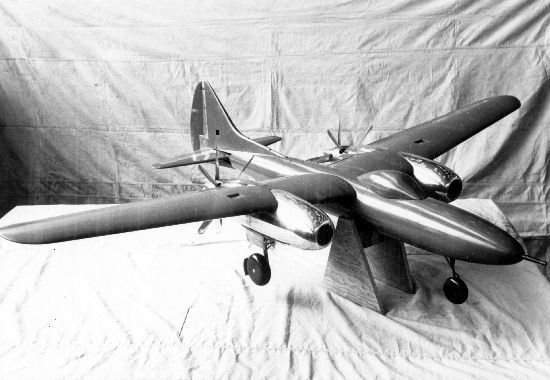
Even when the contract was signed in October 1941, the long timelines for the development of aircraft and engines raised concerns, which were dealt with not very effectively by delaying contract signature until March. While the big gun could in theory achieve a kill at a long range, developing an aiming and rangefinder system that would enable such hits was a complex task. And ground tests of the cannon installation in February 1943 resulted in back-to-the-drawing-board damage. The project managed to stretch its life until October 1943, when it was cancelled, before a prototype was completed. It was never a very good idea.
Leave a Reply