
Preparations for War
Zerstörer
Already in 1932 specifications were prepared for the next generation of aircraft for the secret German airforce. They included a single-seat and a two-seat fighter, both single-engined. The two-seat fighter would be a multi-role type, suitable for air combat, ground attack, day and night reconnaissance, light bombing, and the release of chemical weapons. Notably, all this was planned by the Weimar republic, before the Nazis toppled it. But in January 1933 Hitler came to power, and subsequently the Reichs Aviation Ministry (RLM) was created, with Hermann Göring at its head. Before the end of the year the re-armament programme was revised. New specifications were issued in 1934.
The single-engined, two-seat fighter of 1932 was replaced by a twin-engined ‘Zerstörer’, with a crew of 3 or 4. The actual role of this substantially larger aircraft was only loosely defined, but it was primarily a fighter; long-range reconnaissance was to be a secondary task. A maximum speed of 400 km/h at 6,000 m was called for, and the ability to reach this altitude in 15 minutes. Range was to be 2000 km at the 330 km/h cruising speed. Landing speed was restricted to no more than 100 km/h, which had important implications for the wing area and loading. Crucially, there was no detailed specification of the armament, so the designers were left to choose for themselves how to install the two 20-mm cannon and two machineguns required.
It is useful to compare this with the contemporary specification for a single-seat fighter, which was “Re-armament Aircraft IV” (the Zerstörer was defined as “Re-armament aircraft III”). This specified the same level speed and the same operational ceiling, but far superior climb performance; the single-seater was to reach 6000 m in 7 minutes! The single-seat fighter specification did not specify range, but instead a duration of 1 h 30 min at full throttle at 6000 m, suggesting a defensive instead of an offensive role. Armament was also lighter, at two machine guns (with a large ammunition supply of 1000 rounds per gun) or one cannon. The emphasis on high rate of climb fit in with a global trend for defensive fighters, which were expected to be scrambled from their airfields to intercept enemy bombs. In contrast, the multi-seat type was expected to roam over enemy territory.
The largest of the contenders for the order was the Focke-Wulf Fw 57. With an empty weight of 6,800 kg and a wing span of 25 m, this was close in size to a medium bomber. It was intended to be powered by two DB 600 V-12 engines, but Rolls-Royce Buzzards were installed instead for the first flights, because the DB 600 was not yet ready. The flat nose of the Fw 57 was intended to carry a pair of 20-mm MG-FF cannon on semi-flexible mounts, i.e. with a restricted range of movement, while a Mauser-developed dorsal turret would contain a third cannon. It flew in early 1936, without the armament (which was never installed) but the performance of this overweight and underpowered aircraft fell well below the requirements. Only the three prototypes were completed.

The Henschel Hs 124 was lighter and smaller, with an empty weight of 4,250 kg and a wing span of 18.20 m. The three prototypes were completed to different configurations: The first one carried a mock-up of a planned nose turret with a Rheinmetall-Borsig cannon, and was powered by Jumo 210C engines. The second example had BWM 132Dc radial engines, and the nose turret was replaced by a glazed nose with a vertical slot, intended for the installation of two 20-mm cannon. The third prototype was completed as a two-seat aircraft with two 20-mm and two 7.9-mm guns fixed in the nose; the intended DB 600 V-12 engines had to be replaced by BWM 132 radials. The Hs 124 left a rather better impression than the Fw 57, but any series production was prevented by the success of the Bf 110.

| Focke-Wulf Fw 57 | Henschel Hs 124 V2 | |
|---|---|---|
| Engines | Daimler-Benz DB 600 | BMW 132c |
| Power | 2 x 960 hp | 2 x 850 hp |
| Wing Span (m) | 25.00 | 18.20 |
| Length (m) | 16.57 | 14.50 |
| Height (m) | 4.10 | 3.75 |
| Wing Area (m2) | 73.50 | 54.60 |
| Empty Weight (kg) | 6800 | 4250 |
| Loaded Weight (kg) | 8300 | 7320 |
| Max. Speed (km/h) | 404 km/h at 3000 m | 410 km/h at 3000 m |
| Climb | 2000 m in 4.4 min | |
| Range (km) | 2450 | |
| Guns, fixed | ||
| Guns, flexible | 2 x 20 mm Ikaria MG-FF | 2 x 20 mm |
As in the case of the Bf 109, Willy Messerschmitt ignored parts of the official specification with the Bf 110. The Bf 110 was the smallest of the contenders, with a wing span of 12.6 m. It was basically a two-seat design, although a third crew member could be seated if required. There was a single defensive gun at the rear of the cockpit canopy, but all other armament was to be fixed. This helped to reduce the size and weight of the aircraft and, given the limited power of the available engines, increased its performance.
The third prototype was the first to carry any armament, four fixed 7.92-mm MG 17 machine guns in the upper nose. On production aircraft, two MG-FF cannon were installed in the lower fuselage, firing through long blast tubes that ended at the lower side of the nose. This put the breeches of the cannon and the ammunition magazines behind the pilot’s seat. The second crewmember operated a single MG 15 machine gun to defend the rear.
The prototype had DB 600 engines, but these were not available for the production B-0 and B-1 series. With Jumo 210D engines, performance of the B-series fell well short of that of the prototypes. But the Daimler-Benz DB 601A was installed in the Bf 110C, D and E series from late 1938 onwards, and with these engines, the Bf 110 could fly at 510 km/h at 5,000 m altitude.
There was, however, a competing design that promised to achieve higher performance. At Focke-Wulf, the disappointing results of the twin-engined Fw 57 and the single-engined Fw 159 (a parasol-wing aircraft that competed with the Bf 109) inspired Kurt Tank to design a radical, small twin-engined fighter. There was no official requirement for such an aircraft, but the RLM was sufficiently impressed to write a contract around Focke-Wulf’s design in late 1935. The first flight of the new Fw 187 was made in April 1937, and it proved to be faster than the contemporary Bf 109B.
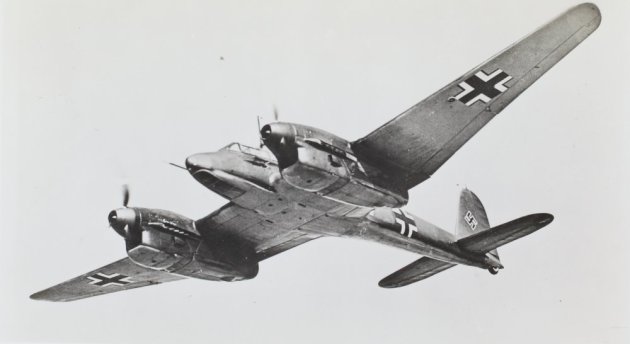
However, this Fw 187 did not qualify as a Zerstörer. Officially, it was classified as a light fighter, being single-seat and armed only with two MG 17 machine guns. As such it competed with the Bf 109 rather than the Bf 110, and the small speed advantage over the Bf 109, and the larger advantage in range, hardly appeared to justify the cost of an additional engine. The RLM desired a second crew member, and the addition of two 20-mm MG-FF cannon to the fixed armament. Two prototypes were completed in the two-seat configuration with Jumo 210 engines, and two more with DB 600 engines. The inevitable downside of these modifications was that the loaded weight of the small fighter rose rapidly, while range decreased.
Only three Fw 187A-0 pre-series aircraft were completed. By all accounts, the pilots who flew them on operations in Norway during the winter of 1940 were greatly impressed by these aircraft. Armament consisted of four fixed MG 17s, installed in the sides of the fuselage just below the sill of the cockpit canopy, and two MG-FF cannon in the lower fuselage. But the Luftwaffe still preferred the Bf 110, which was larger and roomier, and therefore more adaptable to other tasks.
| Messerschmitt Bf 110C-1 | Focke-Wulf Fw 187A-0 | |
|---|---|---|
| Engines | Daimler-Benz DB 601A-1 | Junkers Jumo 210Ga |
| Rating | 2 × 1100 hp | 2 × 730 hp |
| Wing Span (m) | 16.25 | 15.30 |
| Length (m) | 12.07 | 11.12 |
| Height (m) | 4.13 | 3.90 |
| Wing Area (m2) | 38.40 | 30.40 |
| Empty Weight (kg) | 5,600 | 3,700 |
| Loaded Weight (kg) | 7,200 | 5,000 |
| Max. Speed (km/h) | 540 km/h at 6,000 m | 529 km/h at 4,200 m |
| Climb | 660 m/min | 1050 m/min |
| Ceiling (m) | 10,000 | |
| Range (km) | ||
| Fixed Guns | 2 × 20 mm Ikaria MG-FF 4 × 7.92 mm MG 17 | 2 × 20 mm Ikaria MG-FF 4 × 7.92 mm MG 17 |
| Flexible Guns | 1 × 7.92 mm MG 15 |
Even more radical concepts were being developed at Arado. From 1935 onwards, designer Walter Blume worked on a twin-engined, twin-boom aircraft with large, streamlined gun turrets on the upper and lower side of the central nacelle. These would have a free field of fire towards the front and rear, because of the absence of a central tailplane between the booms: The horizontal tails were to extend to the outside of the fins only. By 1937 this had evolved in a project E 500, which was to have two powered gun turrets with two 20-mm Rheinmetall-Borsig Lb 202 cannon each. The RLM initially showed some interest, but soon lost it.
Arado then started work on a Zerstörer with fixed armament. Project E 651 of 1937 envisaged a streamlined four-seat aircraft, with two Daimler-Benz engines buried in the wing/fuselage blending, driving tractor propellors on the wings through a gearbox and shafts. This was rejected by the RLM as too complicated, but it must have left a mark. When in 1938 work was started on a successor for the Bf 110, Arado was given the opportunity to compete with Messerschmitt, and encouraged to be radically innovative.
Meanwhile, the Bf 110 did become the standard twin-engined fighter of the Luftwaffe. The Zerstörer were soon regarded as the elite of the German air force, perhaps because they embodied the aggressive spirit of the new German regime better than the short-ranged Bf 109, which primarily was a defensive fighter. Accordingly, the aircraft was given much publicity by the Nazi propaganda ministry, and the sleek Bf 110 became the inspiration for a series of foreign designs. After a decade in which twin-engined fighters had almost invariably been disappointments, the category suddenly became fashionable again.
To be fair to the air forces and design teams, both the advance of aeronautical technology and the tactical thinking of the time favoured the twin-engined concept. The single-engined fighter was evolving towards the combination of the smallest and sleekest possible airframe with the largest possible engine. This combination resulted in fast, agile fighters with a minimal range, such as the Bf 109 and Spitfire. These were highly optimised for air defence operations (directed by radar, which was secretly being developed in several countries simultaneously) against the new fast bombers, but handicapped in supporting offensive operations. This created a niche for a larger aircraft, and most assumed that it would have to be twin-engined to achieve anything like the performance of the smaller type. Advances in technology eliminated the numerous struts and wires that had handicapped the performance of older designs, and made it possible to design heavy fighters that were aerodynamically efficient.
It remained to be seen how the new twin-engined fighters would perform in actual combat. At the outbreak of the Second World War, the Bf 110 was the equal or the better in performance of most fighters in service; only the Bf 109 and Spitfire were clearly superior. Over Poland, Norway, and France, against weak opposition in the air, the Bf 110 proved quite effective on offensive missions, including interception, air superiority and ground attack. But even over Poland, where the opposition consisted mainly of the antiquated PZL P.11 fighter, crews flying escort missions for bombers felt vulnerable, because they were forced to await being attacked. It would soon get worse.
Jachtkruiser
On 16 March 1937 an unusual shape made its first flight in the Dutch skies: The Fokker G.1, a twin-engined, twin-tailboom multi-role aircraft. The two-seat G.1 was classified by the Dutch as a “jachtkruiser” (cruiser pursuit) but could also serve as reconnaissance aircraft and as a light bomber, having a small internal bomb bay. The prototype had French engines, 690 hp Hispano-Suiza 14AB radials, because Fokker was hoping to get orders from France: There was no official Dutch requirement for the G.1, which was a private venture. The unreliable 14AB engines were later replaced by American 825 hp R-1535-SB4-G Twin Wasp Junior radials. When the Dutch government placed an order, it chose the 830 hp Bristol Mercury VIII engine, which already powered other Dutch aircraft. Because of the size of the Mercury engine and its propellers, and the desire of the Dutch Military Aviation to accommodate a crew of three, that version was significantly bigger and had important structural differences. Empty weight rose from 3405 kg for the Wasp-engined version to 4780 kg for the Mercury-engined version, though speed also improved from 437 km/h to 475 km/h. It thus was a bit heavier than the Bf 110C with significantly less engine power, and couldn’t match its German equivalent in performance.
The G.1 was a clean cantilever monoplane, but under its skin the structure largely followed the traditional Fokker pattern: A wooden wing, with plywood skinning, and a fuselage that combined welded steel tube and wood. Only the tailbooms were light alloy semi-monococque structures, and the nose cover was duraluminium. The short fuselage ended in a “Fokker conical turret”, a grand name for a cone that rotated around its horizontal axis, with a slot for a machine gun. This feature was disliked by its Dutch operators, because the tail booms and tailplane restricted the field of fire too much, and they insisted that any successor design would need a real tail turret.
The performance was not particularly exciting by the standards of the time, and the French decided that the G.1 wasn’t better than their own Potez 63. However, it was slightly faster than the Fokker D.XXI, a single-engined aircraft with fixed landing gear, which was the Dutch standard fighter of the period. Fokker found a number of export customers for the two-seat G.1B, while the Dutch military ordered the larger, Mercury-engined, three-seat G.1A. (Most would be delivered with just two seats installed.)

The armament varied with the customer. The original proposal was to have two 23-mm Madsen cannon in the nose, plus two 7.9-mm machine guns, also from Madsen, and one similar weapon in the turret. A proposal to install 20-mm Hispano cannon had to be abandoned because of an excessive shift of the center of gravity. The Dutch G.1A had eight 7.9-mm FN-Browning M.36 guns in the nose instead, and another one was to be fitted in the tail cone, though an older Madsen M.20 weapon was delivered initially. The aircraft was also designed to have a small internal bomb bay, but plans to use the G.1 as a light bomber never matured. Likewise, the course of the war put an end to plans to build the G.I for Sweden as a dive bomber and reconnaissance aircraft.
In May 1940 only 23 G.1s were available for service, but one more G.1A and three G.1Bs were rapidly added. The latter, built for export, received an interim armament of four FN-Browning guns in the nose. After brief and unequal combat, the Luftwaffe overwhelmed the opposition. Production of the G.1 continued for the Luftwaffe, which used it as advanced trainer. This brought the total number of G.1s produced to 62. The G.1 had been ambitious design from a small manufacturer, which lacked the funds to adopt the latest technology or to greatly expand its factory floor space. In 1939 Fokker had proposed a more powerful, all-metal version of the G.1 for the KNIL, the air force of the Dutch East Indies, which was concerned about the maintenance and durability of wooden parts in the warm and humid climate. Price increased from fl. 114,150 for the mixed-construction G.I to fl. 155,800, a 36% increase that reflected the large investment in factory and tooling! But this version was never built.
German bombs destroyed the prototype of the Fokker D.XXIII, an ingenious twin-engined, single-seat fighter. The D.XXIII represented another attempt to achieve high performance by using two engines on a relatively small airframe: It featured two slender tail booms, and a short fuselage with an engine in the nose and at the rear. The prototype had relatively low-powered, air-cooled in-line engines, 540 hp Walter Sagitta I-SR inverted V-12s. First flown on 30 May 1939, it suffered from the predictable problems with the cooling of the rear engine, and only short flights were accomplished. Armament was to be two 13.2-mm and two 7.9-mm machine guns. Any production aircraft would have been substantially redesigned, with a thinner wing.

The concept was to be tried again in another country. In late 1940 the Soviet design team of Aleksandr Moskalyev flew an aircraft that was clearly inspired by the D.XXIII, the SAM-13. It was smaller and lighter, with a loaded weight of only 1183 kg against 2950 kg for the D.XXIII, and powered by 236 hp MV-6 (licensed Renault) engines. Speeds up to 560 km/h are reported to have been achieved during the brief test programme, before this prototype too was destroyed during the German attack.
| Fokker G.1 (Mercury) | ||
|---|---|---|
| Engines | Mercury VIII | |
| Power | 2 x 830 hp | |
| Wing Span (m) | 17.16 | |
| Length (m) | 10.87 | |
| Height (m) | 3.80 | |
| Wing Area (m2) | 38.30 | |
| Empty Weight (kg) | ||
| Loaded Weight (kg) | 4790 | |
| Max. Speed (km/h) | 475 km/h at 4100 m | |
| Climb | ||
| Ceiling (m) | 9300 | |
| Range (km) | 1520 | |
| Guns, fixed | 8 x 7.9 mm FN-Browning | |
| Guns, flexible | 1 x 7.9 mm FN-Browning | |
| Bombs, internal | 400 kg |
Polish hopes
In the middle of the 1930s, future planning for the Polish air force included the concept of a twin-engined multi-role aircraft, to serve as interceptor fighter, attack aircraft, and dive bomber. A mixed armament of cannon and machine guns was specified, while the recommended powerplant was the 8-cylinder, inverted, air-cooled Foka, which was expected to deliver around 600 hp. By 1936 the interceptor fighter role had been dropped, and the requirement refined to primarily one for a dive bomber and attack aircraft, with a secondary fighter role.
The P.Z.L. P.38 Wilk was structurally similar to the P.37 Los bomber, but smaller. It was intended to have two 20-mm Wz 38 cannon and two 7.7-mm machine guns in the nose, while a pair of 7.7-mm flexible guns was installed to defend the rear. Maximum speed was expected to be 520 km/h, but development of the Foka engine ran into severe difficulties, and by the end of 1937 it still was not ready for flight. In May 1938 the second prototype flew with American Ranger SGV-770B engines instead. These delivered only 450 hp, so could be regarded only as a stopgap. The first prototype made its first flight in January 1939 with improved Foka II engines. However, these too were not yet ready for production.
An alternative engine had been identified in the French Gnome-Rhône 14M Mars, a small-diameter radial. This was selected for the P.48 Lampart, a substantially redesigned aircraft, expected to be built in a version with two Wz 38 cannon and four Wz 36 machine guns in the nose, and one with eight Wz 36 machine guns. Top speed would was predicted to be 560 km/h. In September 1939, the prototypes were still being assembled, and both are believed to have fallen into German hands.
French rearmament
On 31 October 1934, the French air ministry issued a specification for a light multi-seat fighter. One of the roles envisaged for this aircraft was that of a three-seat command aircraft, flying in combat with a unit of single-seat fighters, carrying the unit’s commander. More conventional roles were that of two-seat escort fighter and two-seat nightfighter. The aircraft was to weigh less than 3000 kg (a limit later increased to 3500 kg) and have a maximum speed of 400 km/h (soon raised to 450 km/h) at 4000 m. The fixed armament was specified as two 20-mm cannon.
France maintained a substantial number of aircraft manufacturers, and they replied with offers that included the Breguet 690, Hanriot H.220, Loire-Nieuport 20, Potez 63, and Romano R.110. Potez offered the 63 with alternative Hispano-Suiza or Gnome-Rhône engines, the corresponding aircraft becoming the models 630 and 631, respectively. The Loire-Nieuport design never materialized, but prototypes of all the others were built.
The Breguet 690 was a neat mid-wing monoplane with a dolphin-shaped fuselage and twin tail fins. With 680 hp Hispano-Suiza 14Ab radials, it reached a speed of 490 km/h at 4000 m. Armament consisted of two fixed 20-mm cannon and a 7.5-mm machine gun in the rear cockpit. This aircraft held promise, but it made its first flight in March 1938, when the Potez 63 had already been selected to fill the fighter requirement. The 690 was further developed as attack aircraft.
The Hanriot H.220 looked unusual but sleek, with a short fuselage and, in its initial form, long nacelles for the Renault 12Roi in-line air-cooled engines, so that the propellers were well ahead of the nose. With these 450 hp engines the design was underpowered, so 680 hp Gnome-Rhône 14M radials were installed. Serious handling problems (and major structural damage following a forced landing) indicated a need for major redesign. For the time being, it was out of the running.

The Romano R-110 was remarkably awkard. Conservative in structure, with wooden wings and a steel-tube fuselage, it featured a second cockpit, stacked above and behind the normal position of the pilot. This was intended for use as aerial command post, the commander thus being provided with an excellent outside view. Although only powered by 450 hp Renault 12Ro in-line engines, the R-110 was credited with a top speed of 470 km/h, but like the Breguet 690 it flew in March 1938, too late to compete with the Potez 63. Development of this design, which appears to have had little enough potential, was discontinued.
The Potez 630 made its first flight in April 1936, powered by 580 hp Hispano-Suiza 14Hb engines. It was a very elegant, streamlined aircraft: A fuselage of oval cross-section, a low-set wing with straight taper outboard of the engines, close-cowled radial engines, and a tailplane with twin fins. During flight tests a tailplane with dihedral was installed to improve handling, and the engines were replaced by more powerful 14Ab of the same manufacturer. The Potez 630 reached 460 km/h at 5000 m. The second prototype was completed as a 631, with Gnome-Rhône 14M Mars engines, whose smaller diameter resulted in more streamlined engine cowlings, compensating for their lower power, 660 hp at rated altitude against 725 hp for the 14Ab.

The Potez 631 was selected and ordered into production, but because of a shortage of 14M engines, a larger number of Potez 630s were also ordered. The first production aircraft, a 630, was accepted in May 1938. The basic airframe proved robust, easy to fly, and adaptable. Orders also followed for derivatives, such as the 633 light bomber, the 637 observation aircraft, and the 63.11 reconnaissance aircraft. The observer in the 637 had to be content with a small ventral gondola with windows, while the 63.11 had a redesigned nose with large transparant panels.
As usual, the production aircraft were slower than the prototypes. Measured top speed at 4,000 m was 448 km/h for the 630 and 437 km/h for the 631. On the other hand, the lighter 631 reached this altitude in 5 minutes and 6 seconds, while the 630 needed 7 minutes. For their size, these aircraft were too underpowered to show excellent performance. They fell short not only of international standards, but also of the requirements of the current French re-armament plan, the Plan V. But nothing better was available, so relatively large orders were placed for the 631. It was decided to withdraw the 630 from first-line service, because of its unreliable engines.
Production remained disappointingly slow, hampered by shortages of engines, propellers, and guns. On 1 January 1939 the air force should have had a total of 201 model 630 and 631 fighters in service; it actually had 45 and 27, respectively. In the factories, 74 airframes were still awaiting engines, while many of the aircraft delivered had temporary two-bladed wooden propellers, instead of the metal three-bladed service unit. The planned armament of two 20-mm cannon was not available for the first 630s, so they were armed with four 7.5-mm machine guns instead. Many 631s had just one 20-mm cannon fitted, the other being temporarily replaced by a 7.5-mm gun.
At the outbreak of war the deliveries totalled 206 Potez 631s and 85 Potez 630s, but many had not yet reached combat units. In early 1940, the idea of using the aircraft as a flying command post was abandoned, and the last 630s were withdrawn from operational service. To improve the firepower of the 631s, the second 20-mm cannon would be installed during overhaul. It was also intended that four additional machine guns would be added under the wings, but only a handful of aircraft were so modified. Six night fighter groups (GCN, Groupe de Chasse de Nuit) were equipped with Potez 631s in May 1940; the type was no longer present in day fighter units. The derivative Potez 63.11, a tactical reconnaissance aircraft, was in service in significant numbers.
| Potez 630 | Potez 631 | |
|---|---|---|
| Engines | Hispano-Suiza 14Ab | Gnome-Rhône 14M4/5 |
| Power | 2 x 700 hp | 2 x 700 hp |
| Wing Span (m) | 16.00 | 16.00 |
| Length (m) | 11.07 | 11.07 |
| Height (m) | 3.62 | 3.62 |
| Wing Area (m2) | 32.70 | 32.70 |
| Empty Weight (kg) | 2450 | 2450 |
| Loaded Weight (kg) | 3850 | 3760 |
| Max. Speed (km/h) | 460 km/h at 4500 m | 442 km/h at 4500 m |
| Climb | 4000 m in 5 min 56 sec | |
| Ceiling (m) | 6000 | 6000 |
| Range (km) | ||
| Guns, fixed | 2 x 20 mm | 2 x 20 mm |
| Guns, flexible | 1 x 7.5 mm MAC 34 |
Wisely, a programme to find a successor to the Potez 630 had been formally launched in 1937, even before the aircraft entered service. The new A22 requirement specified a top speed of 550 km/h and heavy armament. The aircraft also had to have an autonomy of three hours at an elevated cruising speed, 90% of the maximum speed. The crew, for the moment, remained at three. Because of fears of a shortage of light alloys during wartime, the use of “non-strategic” materials such as wood and steel was recommended.
Further development of the 630 series produced the Potez 670, initially intended as a three-seat long-range fighter, but modified to have a crew of two before the first flight. It was a bit smaller than the 63, and the wing had an elliptical instead of a straight-tapered plan. The 670 was powered by 700 hp 14M radials, but the prototype was subsequently modified to represent the 671 with 800 hp 14AB 12/13 engines. Having made its first flight in March 1939, the type was still undergoing tests at the time of the French defeat, although work on a small production batch was already ongoing. With a top speed of 500 km/h at 6000 m, the 671 failed to meet the A22 specifications.
Hanriot offered the latest developments of the H.220. At first, the wing and engines were retained, and combined with a new fuselage and tail, this becoming the H.220-2. It made its first flight in March 1939 and showed a decent level speed performance, with a top speed of 532 km/h at 5,000 m. However, aerodynamic problems prompted further redesign, including the replacement of the wing. Because Hanriot had been absorbed in the SNCA du Centre, the aircraft was renamed the Centre NC.600. The first flight was made on 15 May 1940, after the German attack, precluding any possibility of series production. With two 710 hp 14M0/01 engines, the top speed was raised to 542 km/h. Armament was two 20-mm HS.404 cannon and two 7.5-mm MAC34 machine guns in the nose, and a flexible 20-mm cannon for the defense of the rear. The latter was stowed in a slot in the rear decking when not in use.
The most radically innovative of the A22 fighters was known at first as the Lioré et Olivier LeO 50. But before the prototypes were ordered Lioré et Olivier was absorbed in the SNCASE, the Societé Nationale de Constructions Aéronautiques du Sud-Est, also simply known as Sud-Est, and the aircraft became the SE.100.
The SE.100 was designed around a wooden wing, of small area but with extensive flaps to keep the landing speed down. Instead of normal ailerons, a large part of the wingtip was made movable, a design that was thought to provide more room for flaps on the trailing edge of the wing. The fuselage was constructed from steel tube and wood, was well streamlined, and unusually short; it ended in a large tailplane with twin fins. The landing gear consisted of a large retractable nosewheel and smaller wheels retracting into the lower part of the tail fins. Armament initially included two fixed 20-mm HS.404 cannon, and a single HS.404 on a hydraulically-powered mount to defend the rear; the latter could be neatly stowed in the rear decking of the fuselage when not in use.
The SE.100 looked futuristic, but below the sleek skin its wood and steel structure was heavy. The prototype weighed 5,732 kg empty and 7,679 kg loaded. With two 900 hp Gnome-Rhône 14N-0 engines, the SE.100 needed 8 minutes and 20 seconds to climb to 4,000 m, and its top speed of 547 km/h at 4,400 m was well below the 600 km/h expectation of its designers. Hope was not abandoned; the design team considered production versions of the SE.100 with a lighter structure, more powerful engines, and much more powerful armament: One three-seat attack-bomber version was to have six forward-firing HS.404 cannon, a single HS.404 and two 7.5-mm machine guns in a ventral gondola, and a HS.404 at the tail. The defeat of May 1940 meant that all such plans were to remain dreams.
Leave a Reply