The Outlier
As we arrive at the end of the history of the medium bomber in WW2, we also arrive at an anomaly. In the preceding chapters, many types have been critiqued for inadequate defensive armament, and we tracked some of the efforts that combatants made to improve it. Nevertheless, a major factor in the future of the entire class was an aircraft that dispensed with defensive armament entirely.
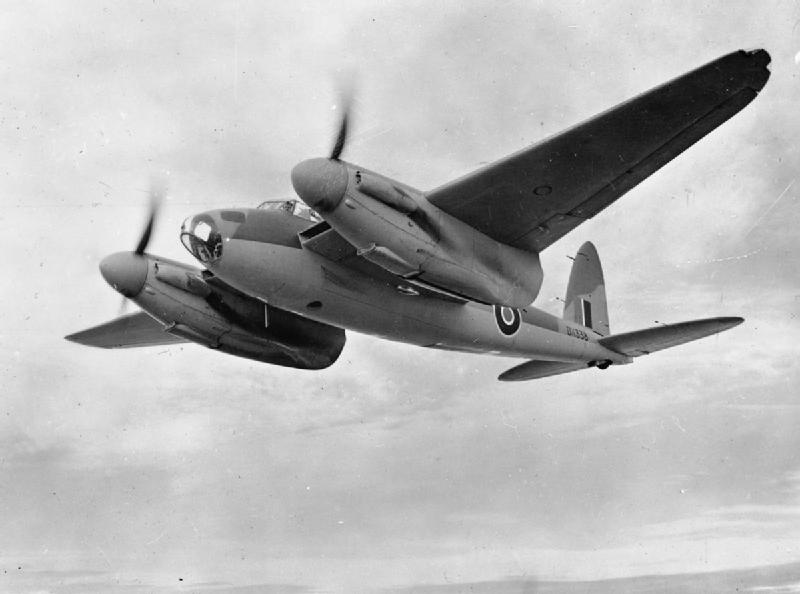
The de Havilland Mosquito came into being by a critical evaluation of the RAF’s Specification P.13/36, which sought a high-performance, heavily armed twin-engined bomber. The specification would ultimately lead to the development of the four-engined Lancaster and Halifax, but de Havilland, probably rightly, felt that P.13/36 was unrealistic. Instead, the firm proposed a smaller aircraft which would rely on speed to avoid interception, and not have any defensive armament. By September 1939 this had been developed to a concrete proposal for a bomber that would carry 1000 lb (454 kg) over 1500 miles (2400 km) and would be as fast or faster than the fighters in service. Specification B.1/40 was written around this proposal, and it envisaged that the new bomber would cruise at 327 mph (526 km/h) and have a maximum speed of 397 mph (639 km/h).
There was a simple enough logic to this. If the defensive armament on existing bombers was inadequate to defend them against attack (and early wartime experience would show that it was, woefully so) then why carry it and the men needed to operate it? The additional weight and volume would snowball into a larger aircraft, heavier structures, more equipment, more fuel. Omitting defensive armament allowed higher speeds to be reached with the same engine power. And speed wasn’t just a matter of racing an enemy fighter on the straight and level. Enemy interceptors had to take off, climb, and then manoeuver themselves into a suitable attack position; eroding their speed advantage would make this much more difficult for them. The idea was at best controversial within the RAF, but the potential of the B.1/40 as reconnaissance aircraft and heavy (night) fighter helped to justify an order. The first contract for 150 Mosquitoes purposely left open for what role the aircraft were to be completed. Perhaps an indication of priority was that the RAF designated the various options as the PR.I reconnaissance aircraft, F.II fighter and NF.II nightfighter, T.III trainer, B.IV bomber, B.V bomber (with a strengthened wing and the ability to carry external fuel tanks or bomb racks), and the FB.VI fighter-bomber. Reconnaissance models were the first to go into service, in June 1941. The B.IV bomber model wasn’t delivered to an operational unit until November, and its first operational missions were flown in May 1942. (The B.V was to remain a prototype, but its wing was adopted for other versions.)
One of the challenges of making the Mosquito operational was the development of suitable bombs. The bomb bay could initially hold four 250 lb bombs, a relatively light load, but modifications to the tail fins of the bombs made it possible to fit four 500 lb weapons in a modified bomb bay. For low-level bombing, fuses with an 11-second delay would be used to avoid damage to the aircraft. Pathfinders could instead drop the 250lb TI “target indicator”, which in the air released 60 pyrotechnic “candles” to create a bright spot on the ground.
Incidentally, the 250 lb and 500 lb GP (“general purpose”) bombs available to the RAF in the early war years were ineffective weapons. They had a good aerodynamic shape, but their weight was too much metal and too little explosive. The British decided to copy German bomb designs, introducing the MC (“medium capacity”) and the HC (“High Capacity”) series. The cylindrical HC didn’t make much concessions to aerodynamics, precision being sacrificed to maximise explosive content. Four 500 lb MC became standard for the bomber Mosquito. A small number of aircraft would be modified to carry a single 4000 lb HC or MC bomb, but this load created stability problems and affected the handling and performance of the B.IV. The later B.XVI with high-altitude rated Merlin engines was a more acceptable carrier of the heavy bomb.

The PR.I and the B.IV carried no guns at all. The F.II and FB.VI had powerful offensive armament in the form of four .303 (7.7 mm) machine guns fixed in the nose cone, and four 20-mm Hispano cannon in the belly, occupying the front of the bomb bay. (The FB.XVIII, built in small numbers, had a single 57-mm Molins cannon instead.) The FB models thus had their internal bomb bay capacity cut by half, to two 500 lb bombs, but bomb load could be restored by carrying two more of these bombs under the wings. Late in the war, FB models were fitted with rocket launching rails under the outer wing panels.
Also in late 1944, the B.IX model introduced Merlin 72 engines with two-speed, two-stage superchargers. Until then the Mosquito had been fitted with Merlin engines in the 20-series, i.e. with single-stage two-speed superchargers. The new engines gave a boost to high-altitude performance, and the later B.XVI would be fitted with a pressure cabin in addition. But the installation of high-altitude engines in fighter and fighter-bomber versions did not follow until the NF.30 nightfighter model near the end of the war.
The sheer diversity of roles and operations to which the aircraft was assigned makes it easy to lose sight of some of it. Best remembered are perhaps some of the spectacular “special” operations that it participated in, against targets varying from Amiens prison to the SS headquarters in Copenhagen and Oslo.
More organically, the Mosquito participated in the strategic bomber offensive with the night missions of the “Light Night Strike Force” against targets in Germany, and Mosquitoes equipped with precision navigation equipment also played a vital role as “Pathfinders” marking targets for the heavy bomber force. Persistent attacks by relatively small Mosquito formations were a matter of great concern for the Luftwaffe, which failed to develop an effective defence against them. Most German nightfighters were too slow. From the late summer of 1943, they themselves increasingly became the prey of Mosquito nightfighters, which roamed over enemy territory to eliminate these threats to the heavy bomber formations. A German nightfighter that approached a Mosquito at night, might well discover that its target was an enemy nightfighter waiting to turn the tables on its pursuer.
A lot of ink has been spilled about the potential of the Mosquito to replace the heavy bombers of the RAF. A 1944 analysis by the Ministry of Aircraft Production concluded that the Lancaster was 2.8 times as expensive to build as a Mosquito, and survived on average only 28 sorties, while the Mosquito night bomber averaged 92. The bomb load of a Lancaster was nearly four times that of a standard Mosquito, but this advantage was reduced if the latter was modified to carry the 4000 lb HC bomb. On paper at least, this made the Mosquito by far the more economic vehicle to deliver explosives to Germany. One has to consider that the 4000 lb HC bomb was an inaccurate weapon and the Mosquito was not the best carrier for the relatively light but voluminous incendiary bombs; and besides there were never enough Mosquito bombers around to make this replacement possible.
And this debate perhaps overlooks that fighter-bomber models of the Mosquito accounted for nearly a third of the production run; the Mosquito version built in the largest number was the FB.VI. This model entered service in the late summer of 1943, which turned out to be timely as from December 1943 onwards the RAF could use the type against V-1 launching sites on the continental coast. Functionally it replaced light and medium bomber types in the 2nd Tactical Air Force. (Starting with the Lockheed Ventura, which had proved unsuitable.) The fighter-bomber model was very well suited for low-level attacks against targets such as bridges and V-1 launching sites. It carried a smaller bomb load than medium bombers such as the B-25 or B-26, but dropped its bombs with more accuracy, which may have been a function of the employed tactics more than the airframe. It was calculated that Mosquito bombers destroyed, on average, a launch site for every 40 tons of bombs dropped. The B-17, B-25 and B-26 all needed at least four times as much.
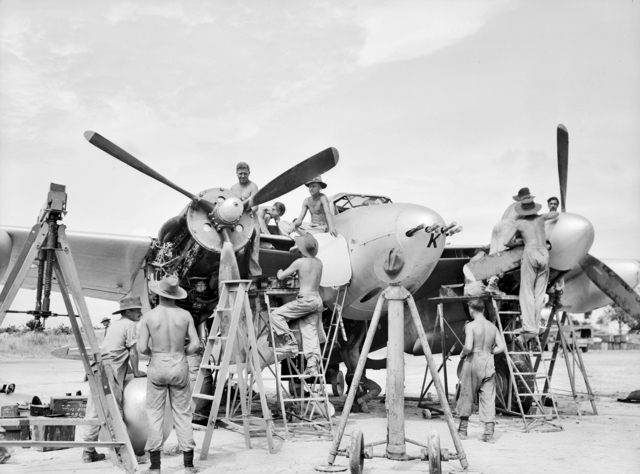
The type also operated with Coastal Command in an anti-shipping role, targeting German supply lines and warships both on the French and the Norwegian coast. These could be hard targets as the Germans developed escort vessels equipped with an extensive array of anti-aircraft guns. Here the versatility of the type served it well, as machine gun and cannon fire would be used to suppress the defences, before rockets and bombs were employed to sink the ships.
How to assess the Mosquito? The aircraft was famously built of wood, though this was for industrial and economic reasons and similar or better performance could have been achieved with modern metal construction. The production run of 7,781 (of which 6,710 during the war) was roughly equivalent in size to that of the Avro Lancaster or Handley Page Halifax, although it was handsomely surpassed by that of the Vickers Wellington. The closest functional equivalent outside Britain was probably the Junkers Ju 88, which had about twice the production run. For a type that excelled in so many different roles, the Mosquito was perhaps not built in adequate numbers, despite the early decision to set up a production line in Canada as well. One consequence was that US demands for photo-reconnaissance Mosquitos could not be met.
The decision to omit defensive armament turned out to be a good one. The Mosquito was by no means entirely immune to interception and from the start, aircraft were shot down by German fighters. This was less of a risk at night as the Mosquito generally outperformed German nightfighters. Tactical bombing missions flown by daylight, however, exposed the Mosquito to interception by Bf 109s and Fw 190s, and a fighter escort was highly desirable. This, however, was equally needed by more conventional bombers. In practice, entrusting the defence of the formation to escort fighters was a far superior option. Nobody had predicted that before the war.
The Mosquito crossed boundaries as it was the size of a light bomber, with initially a quite modest load capacity, but flew both strategic and tactical missions. However, its greatest contributions to the strategic bomber offensive were probably made by reconnaissance models, target markers, and nightfighter models – the latter inflicted a painful defeat on the German Nachtjagd, once the RAF finally decided to take the risk of using its newest radar technology over Germany. (Arguably more could have been done, and earlier.) Its contribution as a tactical bomber, striking precision targets, should not be overlooked.
The tantalising what-if question is what would have happened if the Anglo-French purchasing commission had taken this concept to US manufacturers in 1939. It was perhaps too controversial to do that. But one can imagine that the result might have been a fast two-seat aircraft of all-metal, flush-riveted construction, powered by a pair of R-2800 radials, and wonder how this would have stacked up against the A-20, B-25 and B-26; or even the B-17 and B-24. The technological potential for such an aircraft was certainly there, but the doctrine to justify its design was not. Only late in the war would the USAAF receive the fast A-26.
The multi-role Mosquito was a not a true medium bomber. Conceptually if not doctrinally, it was an ancestor of the heavy jets that would eventually displace the medium bomber from air force inventories: Types that equally combined fighter-like performance with the ability to carry heavy offensive loads.
 Flying Guns